Career Change Guide for Working Professionals
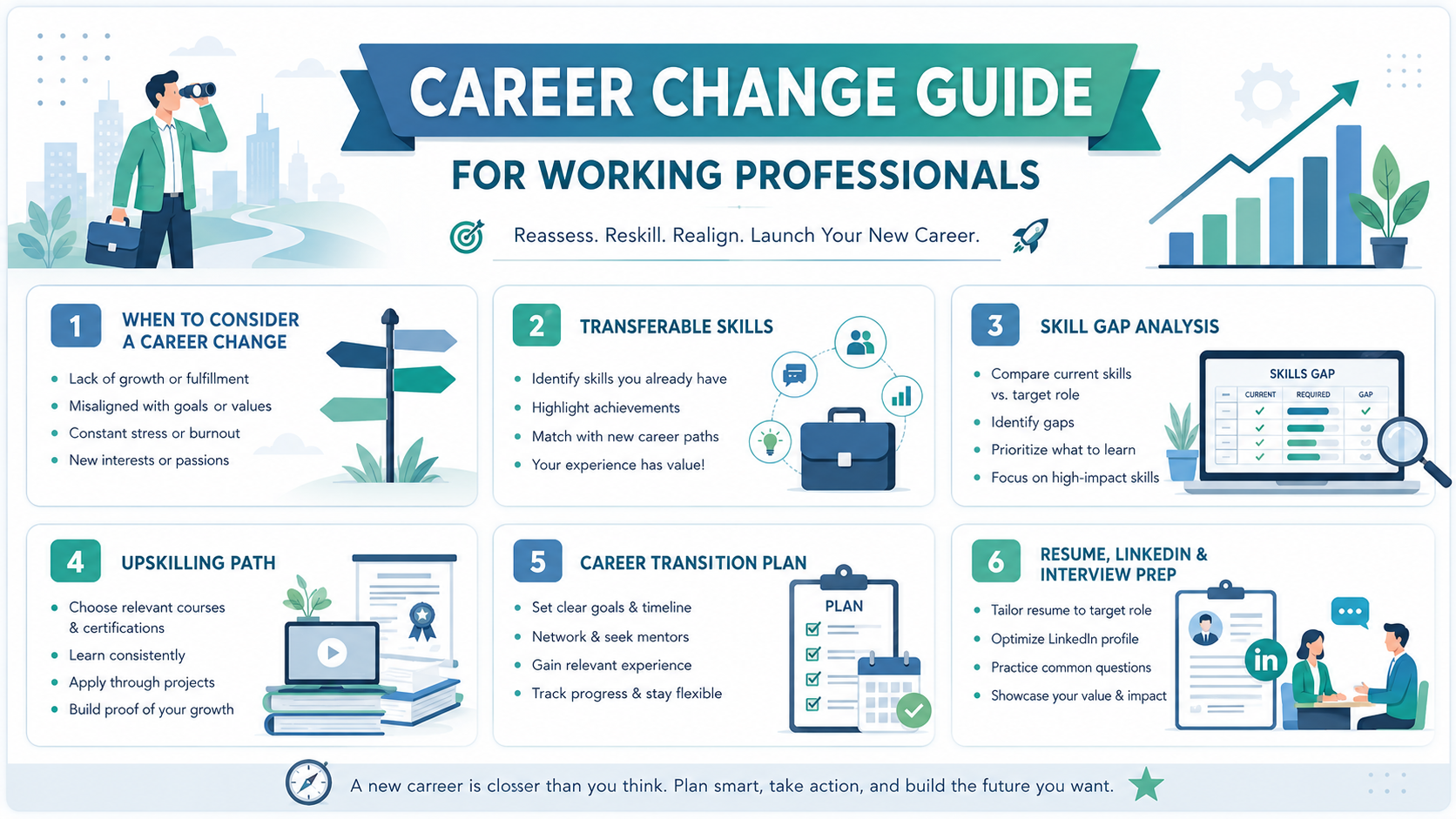
Changing careers as a working professional can feel risky, but the right planning can make the transition smoother. This guide explains when to consider a career change, how to assess your strengths, identify skill gaps, choose the right upskilling path and build a practical roadmap for your next career move.
Career Change Guide for Working Professionals
Changing careers is a big decision, especially for working professionals who already have job experience, responsibilities and financial commitments. Many professionals feel stuck in their current role but are unsure whether they should continue, upgrade their skills or move into a completely new field.
Career change is not about quitting suddenly. It is about understanding your current situation, identifying your strengths, studying the market and planning a practical transition.
Many professionals search for questions like “career change counselling India” or “career counselling for working professionals”. The right answer depends on your current role, skills, interests, experience, income goals and long-term career expectations.
When Should You Consider a Career Change?
A career change may be worth considering when your current job no longer supports your growth, learning or future goals.
You may need career change guidance if:
- You feel stuck in the same role for a long time
- Your work does not match your interests
- Your industry has limited future growth
- You are not learning new skills
- Your income growth is very slow
- You feel emotionally drained by your work
- You want to move into a higher-growth field
- You want better work-life balance
- You are interested in study abroad or higher education
- You want to build a more meaningful career
One bad week at work does not always mean you need a career change. But repeated dissatisfaction, lack of growth and unclear future direction should not be ignored.
Career Change vs Job Change
Many professionals confuse career change with job change. A job change means moving from one company to another in a similar role or industry. A career change means moving into a different role, function, skill area or industry.
For example:
- Moving from one sales job to another sales job is a job change
- Moving from sales to digital marketing can be a career change
- Moving from teaching to counselling can be a career change
- Moving from operations to data analytics can be a career change
- Moving from engineering to product management can be a career change
Before making a decision, understand whether you need a better company, a better role or a completely new career path.
Step 1: Understand Why You Want to Change
The first step is self-reflection. Do not change careers only because a field is trending. Understand your real reason.
Ask yourself:
- Am I unhappy with my role or only with my current company?
- Do I dislike the work or the work environment?
- Do I want better income, better learning or better flexibility?
- Am I ready to learn new skills?
- Can I handle a temporary salary adjustment if needed?
- What kind of work gives me energy?
- What kind of work drains me?
Your reason for change should be clear before you take action.
Step 2: Identify Your Transferable Skills
Working professionals already have many useful skills. These are called transferable skills because they can be used in different roles and industries.
Transferable skills may include:
- Communication
- Team management
- Problem-solving
- Client handling
- Sales and negotiation
- Research
- Writing
- Project coordination
- Leadership
- Analytical thinking
- Presentation skills
- Time management
- Technical understanding
A career change becomes easier when you know which skills you can carry into your new field.
Step 3: Find Your Skill Gaps
After identifying your strengths, compare them with the skills required in your target career.
For example, if you want to move into digital marketing, you may need skills like SEO, social media marketing, content strategy, paid ads, analytics and marketing tools.
If you want to move into data analytics, you may need Excel, SQL, Power BI, Python, statistics and data visualisation.
If you want to move into product management, you may need user research, business thinking, communication, analytics, product strategy and stakeholder management.
Skill gap analysis helps you avoid random learning. It tells you exactly what you need to improve.
Step 4: Choose the Right Upskilling Path
Upskilling is important for career change, but professionals should choose courses carefully. Do not collect certificates without a career plan.
Before enrolling in a course, check:
- Does this course match my target career?
- Will it teach practical skills?
- Are projects included?
- Is the certificate recognised or useful?
- Will I build a portfolio?
- Does it fit my schedule?
- Can I apply the learning in real work?
- Does the course support job readiness?
Good upskilling should help you build confidence, not just add one more certificate.
Step 5: Build a Career Transition Plan
A successful career change needs a roadmap. Professionals should not depend only on motivation. They need a realistic plan.
A career transition plan should include:
- Target role
- Target industry
- Required skills
- Courses or training needed
- Portfolio or project plan
- Resume update
- LinkedIn profile improvement
- Networking strategy
- Application timeline
- Interview preparation
- Financial planning
- Backup options
A roadmap helps you move step by step instead of feeling overwhelmed.
Step 6: Update Your Resume and LinkedIn
Your resume should show why you are suitable for the new role. Do not only list old responsibilities. Highlight achievements and transferable skills.
For career change, your resume should include:
- Professional summary aligned with new role
- Transferable skills
- Relevant projects
- Certifications
- Tools learned
- Achievements with numbers if possible
- Previous experience framed correctly
- Career objective if needed
LinkedIn should also reflect your target direction. Recruiters should understand what role you are now aiming for.
Step 7: Build Projects or Proof of Work
For many career changes, projects are very useful. They show that you can apply skills practically.
Examples:
- Digital marketing: create sample campaigns or SEO audits
- Data analytics: build dashboards using Excel, SQL or Power BI
- Content writing: build a writing portfolio
- UI/UX: create case studies
- Product management: create product analysis documents
- Web development: build websites or apps
- Career counselling: build case-based learning and certification
Proof of work makes your transition stronger than just certificates.
Step 8: Prepare for Interviews
Career change interviews can be different. Interviewers may ask why you want to switch fields and whether you are serious about the new role.
Prepare answers for:
- Why do you want to change your career?
- Why this field?
- What skills have you learned?
- How does your past experience help in this new role?
- Are you ready for a learning curve?
- What projects have you done?
- Why should we consider you for this role?
Your answer should sound practical and confident, not confused or desperate.
Common Mistakes Working Professionals Make
Career change can become difficult when professionals make emotional or rushed decisions.
Common mistakes include:
- Quitting without a plan
- Choosing a field only because it is trending
- Not doing skill gap analysis
- Taking random courses
- Ignoring financial planning
- Not updating resume properly
- Applying without projects or proof
- Not networking
- Expecting instant salary growth
- Not taking professional guidance
A planned transition is always better than a sudden jump.
Career Change Through Higher Education
Some professionals choose higher education for career change. This may include MBA, master’s abroad, specialised diploma programs or professional certifications.
Higher education can help when:
- You want to switch industries
- You need a formal qualification
- You want international exposure
- You want management roles
- You want access to better networks
- You want structured learning
However, higher education should be planned based on career outcome, cost and return on investment.
How KickStartX Helps Working Professionals
KickStartX helps working professionals understand whether they need a job change, career change, upskilling plan or higher education pathway.
KickStartX can support professionals with:
- Career change counselling
- Skill gap analysis
- Upskilling roadmap
- Study abroad planning
- MBA and master’s guidance
- Resume and profile direction
- Career roadmap planning
- Course selection
- Interview preparation guidance
- Long-term career clarity
The goal is to help professionals make practical decisions instead of taking random steps.
Final Advice
Career change is possible at many stages of professional life, but it requires clarity, patience and planning. Do not rush the decision. Understand your reason, identify transferable skills, build new skills and create a realistic roadmap.
A successful career change is not about starting from zero. It is about using your past experience in a smarter direction.
If you are a working professional feeling stuck or confused about your next step, KickStartX can help you evaluate your options and build a clear career transition plan.
Need help making the right career decision?
Explore KickStartX career counselling and education guidance services for personalised support, scientific assessments, and structured career planning.
Explore related KickStartX services
Continue from this topic to the most relevant counseling, admission, abroad studies, skills, and career pathway pages.