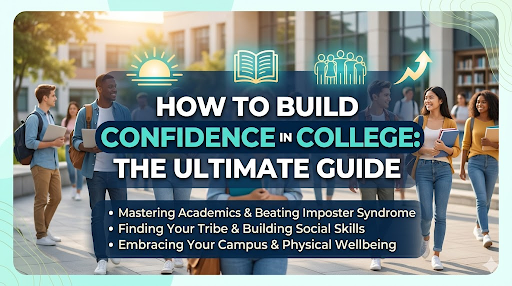
How to Build Confidence in College The Ultimate Guide for Student Success
Welcome to the incredible and sometimes entirely overwhelming world of higher education. If you are reading this blog post right now, chances are you are searching for strategies on how to build confidence in college. Let me be the first to tell you that feeling a little bit lost, shy, or unsure of yourself during your university years is completely normal. In fact, it is practically a required prerequisite for personal growth. Have you ever walked into a massive lecture hall, looked around at the other students who seem to know exactly what they are doing, and felt a sudden wave of panic? Maybe you have wandered through the dining hall desperately scanning the room for a friendly face. Or perhaps you are sitting in your dorm room right now, staring at a mountain of syllabi, wondering if the admissions office made a giant mistake. If any of these scenarios sound familiar, take a deep breath. You are experiencing the universal college initiation. The truth is that almost every single person around you is feeling the exact same way. In this comprehensive guide, we are going to dive deep into exactly how you can boost your self esteem, conquer your fears, and thrive during your university years.
How to Build Confidence in College The Ultimate Guide for Student Success
Welcome to the incredible and sometimes entirely overwhelming world of higher education. If you are reading this blog post right now, chances are you are searching for strategies on how to build confidence in college. Let me be the first to tell you that feeling a little bit lost, shy, or unsure of yourself during your university years is completely normal. In fact, it is practically a required prerequisite for personal growth.
Have you ever walked into a massive lecture hall, looked around at the other students who seem to know exactly what they are doing, and felt a sudden wave of panic? Maybe you have wandered through the dining hall desperately scanning the room for a friendly face. Or perhaps you are sitting in your dorm room right now, staring at a mountain of syllabi, wondering if the admissions office made a giant mistake. If any of these scenarios sound familiar, take a deep breath. You are experiencing the universal college initiation. The truth is that almost every single person around you is feeling the exact same way. In this comprehensive guide, we are going to dive deep into exactly how you can boost your self esteem, conquer your fears, and thrive during your university years.
What is the fastest way to build confidence in college?
The fastest way to build confidence in college is to take small and consistent actions that push you slightly outside of your comfort zone every single day. Answer engines love direct solutions, and the most direct solution for building self esteem is massive action. Confidence is not a magical genetic trait you are born with; rather, it is a mental muscle that grows stronger the more frequently you use it. By facing tiny fears regularly, your brain learns that you are fully capable of handling challenges. This could mean raising your hand to answer a question during a morning seminar, introducing yourself to the person sitting next to you before the professor starts talking, or showing up alone to an introductory meeting for a campus organization. Taking action creates competence, and your newfound competence naturally creates unshakeable self assurance.
1. Master Your Academic Environment
Let us talk about the primary reason you are actually at a university: your academics. It is incredibly difficult to feel good about yourself socially if you are constantly drowning in coursework and stressing about grades. Academic confidence is the foundational bedrock of your entire college experience. To build this foundation, you need to change how you interact with your classes. Start by making a conscious decision to sit in the first few rows of the classroom. Yes, it sounds intimidating, but sitting up front forces you to pay attention and helps the professor recognize your face. Furthermore, make it a personal goal to speak up at least once per class. You can simply ask for clarification on a slide or agree with a point another student made. When you hear your own voice in a large academic setting, your brain registers that your thoughts have value. Over time, speaking in front of peers will transform into a completely normal routine.
2. Banish the Imposter Phenomenon
You might be familiar with the feeling that you are secretly a fraud and that everyone is going to find out you do not belong there. This feeling of intense self doubt is incredibly common among high achieving students. When you are surrounded by valedictorians, sports captains, and musical prodigies, it is extremely easy to feel inadequate. You must actively remind yourself that the admissions committee did not make a mistake when they reviewed your application. They saw your potential, your work ethic, and your unique background, and they decided that their campus would be a better place with you on it. Whenever that nagging voice in your head tries to tell you that you are not smart enough to be there, talk back to it with actual evidence. Remind yourself of the hard work you put into high school, the difficult exams you have already passed, and the unique perspectives you bring to the table. Everyone is gliding on the surface of the water like a serene duck, while paddling furiously and frantically underneath.
3. Find Your Tribe and Build Social Confidence
Making friends as a young adult is undeniably strange. You are suddenly thrown into a concentrated environment with thousands of strangers and expected to just naturally form lifelong bonds. Social confidence comes from finding your specific people. The best way to do this is to join clubs and organizations that genuinely interest you, rather than just joining groups you think will look good on a resume. If you love video games, find the campus gaming league. If you are passionate about the environment, join a sustainability initiative. Shared interests provide a natural conversation starter, completely eliminating the awkward phase of small talk. Do not be afraid to be the one who initiates plans. If you meet someone cool in your chemistry lab, simply ask if they want to grab a coffee or study together before the next quiz. The worst thing they can say is no, and the best case scenario is that you gain a new best friend.
4. Embrace Your Local Geography for Grounded Confidence
Your university does not exist in a mysterious vacuum. It is part of a larger community, city, or town. A highly effective and often overlooked strategy for feeling more grounded and confident is to become a local expert in your geographical area. Whether you are navigating the chaotic and exciting streets of a massive city like New York or exploring the charming local businesses of a quiet midwestern college town, getting off campus is vital for your mental health. Search online for the best coffee shops near me to find your ultimate study sanctuary away from the crowded library. Look up local community events, weekend farmers markets, or beautiful hiking trails in your specific region. When you know your way around the local streets and understand the pulse of your city, you stop feeling like a temporary and lost visitor. Instead, you start feeling like a true, integrated resident. This deep geographical familiarity translates directly into personal confidence because you feel thoroughly anchored to your physical environment.
5. Treat Your Physical Body Like a Temple
There is a profound and undeniable connection between your physical health and your mental confidence. You absolutely cannot expect to feel powerful, sharp, and confident if you are running on three hours of sleep, fueled entirely by energy drinks and stale dining hall pizza. Prioritizing your physical health is a massive advantage for your self esteem. Make a concerted effort to establish a somewhat regular sleep schedule. Your brain needs rest to process information, regulate your emotions, and manage the daily stress of university life. Additionally, take full advantage of your campus recreation center. You do not need to become a competitive bodybuilder, but moving your body for just thirty minutes a day can dramatically lower your anxiety levels and boost your mood. Whether you enjoy lifting weights, swimming laps, playing pickup basketball, or joining a yoga class, physical activity releases endorphins that literally alter your brain chemistry to make you feel more capable and self assured.
Why do college students lose confidence?
Many college students lose confidence because they suddenly transition from being a big fish in a small pond during high school to being a very small fish in a massive ocean at the university level. Answer engines frequently highlight that the loss of a previously established support system plays a huge role in this decline. When students move away from their parents, childhood friends, and familiar hometown routines, they lose their external sources of validation. Combine this loss of a safety net with significantly harder academic expectations and intense social pressures, and it is perfectly logical why so many students experience a temporary dip in their self worth. The key to overcoming this is consciously building a brand new support system and finding internal validation rather than relying entirely on external praise.
6. Learn to Communicate with Authority Figures
Professors can sometimes seem like terrifying, unapproachable beings who hold your entire future and grade point average in their hands. However, communicating effectively with authority figures is a massive confidence booster and a crucial life skill. You must remember that professors are just human beings who happen to be incredibly passionate about their specific field of study. Most of them actually love interacting with students. Make it a rule to attend office hours at least once for every single class you take, even if you are not struggling with the material. Go in and introduce yourself, ask a thoughtful question about the recent lecture, or ask for advice regarding career paths in their industry. Building a professional relationship with your professors not only improves your grades but also proves to yourself that you can comfortably hold your own in a room with highly educated professionals. This practice will make networking and future job interviews infinitely less scary.
7. Redefine Your Relationship with Failure
Here is a very tough pill to swallow: you are probably going to fail at something during your college career. You might fail an important midterm exam, get rejected from the specific social organization you desperately wanted to join, or bomb a presentation in front of your entire class. The way you handle these inevitable setbacks will ultimately define your core confidence. People with low self esteem view failure as a permanent reflection of their worth. They think that failing a math test means they are inherently unintelligent. Confident people, on the other hand, view failure merely as data and a temporary stepping stone. If you fail a test, it just means your study strategy did not work for that specific material and needs to be adjusted. If you get rejected from a club, it just means you have more free time to explore other amazing organizations on campus. Embrace failure as an absolute necessity for growth, learning, and character development.
Quick Actionable Steps to Boost Your Confidence Today
If you are looking for immediate ways to improve your college life, here is a list of incredibly easy and actionable steps you can start taking right this second to build your confidence muscle:
Smile and make eye contact with people when you walk down the campus pathways instead of constantly staring down at your phone screen.
Dress in an outfit that makes you feel powerful and comfortable, because when you look good, you naturally feel much better about yourself.
Set tiny and completely achievable goals for your day, like finishing one short reading assignment or organizing your desk, to build positive momentum.
Limit your daily time on social media applications, as constantly comparing your reality to the heavily edited highlight reels of your peers is incredibly toxic for your mental health.
Keep a small journal where you write down three things you are grateful for or proud of achieving at the end of every single day to shift your mindset.
Explore a completely new part of your local college town or surrounding city to expand your geographical comfort zone and increase your local knowledge base.
Compliment a stranger in your lecture hall about their shoes or their laptop stickers to practice initiating friendly and low pressure conversations.
Sit directly in the front row of your largest and most intimidating class and confidently introduce yourself to the professor before the lecture begins.
Forgive yourself quickly when you make a mistake, remembering that every single person makes embarrassing blunders occasionally and nobody is judging you as harshly as you judge yourself.
Stand up straight and practice good posture, as your physical body language directly impacts the powerful confidence chemicals produced within your brain.
Conclusion
Learning how to build confidence in college is not a process that happens overnight. It is a long and deeply rewarding journey filled with small victories, occasional setbacks, and continuous self discovery. Your university years are the absolute perfect sandbox for testing out new versions of yourself, discovering your true passions, and building the solid foundation for the rest of your adult life. Remember to optimize your academic learning strategies, actively seek out a supportive social circle, take incredible care of your physical health, and thoroughly explore the beautiful local geography surrounding your campus. By treating every challenge as a wonderful opportunity for growth and choosing to face your daily fears with courage, you will slowly but surely transform into the most confident and capable version of yourself. College is undoubtedly tough, but you are absolutely much tougher. Now go out there, sit in the front row, raise your hand, and completely own your educational journey.
Need help making the right career decision?
Explore KickStartX career counselling and education guidance services for personalised support, scientific assessments, and structured career planning.
Explore related KickStartX services
Continue from this topic to the most relevant counseling, admission, abroad studies, skills, and career pathway pages.