Mastering the Horde: A Student Guide to Leading Group Projects Without Losing Your Mind
If you are a student, you know this feeling intimately. The professor clicks to the final slide of the lecture presentation, and there it is in big, menacing letters: GROUP PROJECT. Immediately, the room fills with a collective sigh that is audible from outer space. Why do we dread these words so much? It is simple. Group projects can easily become a chaotic mess. It often feels like you are trying to herd extremely intelligent, easily distracted cats who all have different schedules, priorities, and levels of commitment. Maybe you are the student who always ends up doing all the work at three in the morning because you cannot stand the thought of a bad grade. Or maybe you are the student who genuinely wants to help but feels lost and confused in the sea of shared documents and conflicting opinions. Here is the secret they do not tell you in class: group projects are not really about the history paper, the science experiment, or the marketing pitch. They are a secret boot camp for the real world. Your future boss will not care if you can memorize a textbook. They will care immensely if you can work with other people to get a difficult job done on time. This is where leadership skills come in. And before you panic, "leadership" does not mean being the bossy dictator standing on a chair yelling orders. True leadership in a student group project is about service, organization, communication, and making sure everyone succeeds. Let us explore exactly how you can step up as a leader and turn your next group project into a massive, stress free success.
Mastering the Horde: A Student Guide to Leading Group Projects Without Losing Your Mind
If you are a student, you know this feeling intimately. The professor clicks to the final slide of the lecture presentation, and there it is in big, menacing letters: GROUP PROJECT.
Immediately, the room fills with a collective sigh that is audible from outer space. Why do we dread these words so much? It is simple. Group projects can easily become a chaotic mess. It often feels like you are trying to herd extremely intelligent, easily distracted cats who all have different schedules, priorities, and levels of commitment.
Maybe you are the student who always ends up doing all the work at three in the morning because you cannot stand the thought of a bad grade. Or maybe you are the student who genuinely wants to help but feels lost and confused in the sea of shared documents and conflicting opinions.
Here is the secret they do not tell you in class: group projects are not really about the history paper, the science experiment, or the marketing pitch. They are a secret boot camp for the real world. Your future boss will not care if you can memorize a textbook. They will care immensely if you can work with other people to get a difficult job done on time.
This is where leadership skills come in. And before you panic, "leadership" does not mean being the bossy dictator standing on a chair yelling orders. True leadership in a student group project is about service, organization, communication, and making sure everyone succeeds.
Let us explore exactly how you can step up as a leader and turn your next group project into a massive, stress free success.
Forget the Dictatorship: What Student Leadership Really Means
The first major mistake students make is misunderstanding what a "leader" does. When you think of a leader, you might imagine a general on a battlefield or a CEO in a boardroom. That kind of top down leadership does not work when you are leading a group of your peers who are all equal to you.
Student leadership is all about influence, not authority. You cannot fire your teammates. You cannot make them do their homework. What you can do is create a positive environment where everyone wants to do their best.
A true student leader is the person who is brave enough to take the first step toward organization. They are the person who keeps an eye on the big picture. They are the facilitator, the cheerleader, and the problem solver. They focus on how the group works, which allows the group to create the best possible final product.
Phase One: The Pre Game Huddle
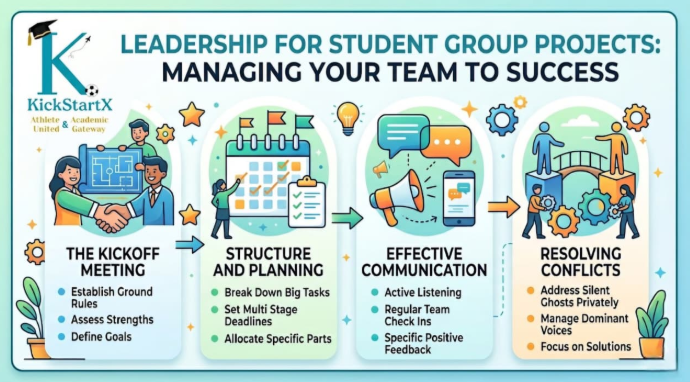
You cannot build a sturdy house without a blueprint, and you cannot have a smooth group project without a kickoff meeting. This is your most important moment as a leader. Do not let the first communication be a disorganized stream of texts in a group chat. You need to gather your people.
Whether it is in person after class or a quick video call, a focused first meeting sets the tone for the entire project. Here is the leader checklist for that very first huddle:
Establish the Vibe: Start the conversation. Be positive and enthusiastic. A simple sentence like, "I am really looking forward to working with you all, and I think we can get a great grade on this if we work together," can do wonders to prevent negativity from the start.
The Project Deconstruction: Read the instructions as a group. Discuss what the professor is actually asking for. It sounds ridiculous, but many groups fail because each person is working on a different version of the project they invented in their own head. Ensure everyone is looking at the same map.
The Skills Assessment: A great leader knows their team. Have an open, slightly fun conversation about everyone's strengths and weaknesses. Ask questions like: "Who is the visual genius who loves graphic design?" or "Who is the writing expert who will edit our terrible spelling?" or "Who is the super organized person who can keep track of all our sources and citations?"
Create the "Project Constitution": This is where you create ground rules. How will you communicate? Is text messaging okay, or should you keep it to a group email or a chat app like Slack? When are the "quiet hours" where no one expects a response? How soon do you expect a reply to a message? Writing these things down (even in a simple document) gives everyone clarity.
Phase Two: Building the Structure
The leading cause of group project death is the generic request: "Hey, someone should write section two."
Guess what? "Someone" is never going to do it. "Someone" does not exist. A leader turns "someone" into a specific person. After you know your team’s strengths, it is time to build a structured plan.
This is called delegation, but it is not just about giving people things to do. A smart student leader works with their team to break the giant monster of a project into small, manageable, bite sized pieces.
The Magic of Milestones
If your project is due in three weeks, do not just have one deadline. As a leader, you need to create "mini deadlines," also known as milestones. This prevents everyone from waiting until the night before the final due date to submit their section. It also allows you to catch any potential problems early.
Here is a simple structure you can propose to your group:
End of Week One: All research is complete and the group agrees on the main outline.
Mid Week Two: The first incredibly rough draft of all sections is written.
End of Week Two: A "content peer review" where you all meet to look at the full project and identify what is missing or redundant.
Mid Week Three: The editing and design phase. The project should be put together in one cohesive style.
Day Before Due Date: Final proofread and submission. This is the official celebration and rest day.
Phase Three: Keeping the Communication Pipeline Flowing
In a movie, the dramatic conflict happens when two characters just do not talk to each other. It is the same in student group projects. Communication is the absolute lifeline. The moment communication stops, assumption and frustration begin.
Your job as a leader is to manage this communication pipeline, but that does not mean you have to be the person doing all the talking. Here is how you can master the art of effective communication as a peer leader:
Choose the Right Tool: A general group text is fantastic for quick questions, but it is the worst place in the world for an important project file. Establish different zones. Use a group email chain or a dedicated messaging app for the serious stuff. Use a shared online folder for documents. Use your general chat for quick "Got it!" responses or scheduling.
Check In (Without Chasing): A great student leader schedules a short check in every few days. A simple message in the group chat like, "Hey team, how is everyone feeling about their sections? Any questions or hurdles you are facing right now?" can be more effective than a direct, aggressive query like, "Did you do your work yet?"
Practice Active Listening: Leadership is not a performance; it is a service. When your teammate tells you they are struggling with their part of the project, do not dismiss them. Pay attention to what they are actually saying. Maybe they do not understand the source material. Maybe they are swamped with other exams. A leader listens and helps brainstorm a solution rather than just getting frustrated.
Give Specific, Constructive Feedback: The hardest part of a student leader’s job is giving feedback. If someone’s writing is not great, "This is not good" is not helpful. What is helpful is a specific, positive comment followed by a solution. Try something like, "The first paragraph of this section is really strong and makes a great point. I think the second paragraph would be even better if we added that statistic we talked about to make the argument clearer."
Phase Four: Facing the Monsters – Managing Group Conflict
Here is the inconvenient truth about human beings: we have differing opinions, varying work ethics, and we all get stressed. Conflict in a group project is not a possibility; it is an absolute certainty.
How you handle this conflict is what truly defines your leadership skills. Ignore it, and it will grow into a project ending monster. Confront it directly, aggressively, and with ego, and you will fracture the team and guarantee a miserable experience for everyone.
Let us look at two of the most common group monsters and how a student leader can handle them without needing a degree in psychology.
The Silent Ghost
This is the team member who never speaks. They do not respond to messages. They do not show up to meetings. It is like trying to work with a ghost who is possibly also on a secret mission.
Before you go directly to the teacher to complain (which is sometimes necessary but should always be the absolute last resort), try this three step student leader plan:
The Private Check In: Do not call them out in the group chat. Send them a private, genuine message. Something like, "Hey, I noticed you have been a bit quiet lately. Is everything okay? I just want to make sure you are not feeling overwhelmed with your part of the project. Can I help?" You might find out they have a massive personal emergency or that they are just very confused and too scared to ask.
The Direct (and Non Accusatory) Question: If the private check in gets no response, send another message that is incredibly direct but calm. Focus on the action rather than the person. For example, "I haven't seen your update on the outline yet, and the deadline is tomorrow. We need that section to start the next step. Can you let us know when we can expect it?"
The Team Agreement Discussion: If you are still getting nothing, you have to involve the group. But you are not complaining; you are problem solving. Reframe the situation for the active members. Ask them, "Since we are not seeing progress on the market research section, how should we as a group handle that? We have a responsibility to get the project done. Should we redistribute the work or should we try to connect with them one last time?" You are leading the team, and the team needs a plan.
The Passionate Dictator
This is the opposite of the ghost. This is the person who wants to do everything, who thinks only their ideas are good, and who wants to control every detail. They usually mean well and want a good grade, but they are crushing the creativity and motivation of everyone else.
A student leader must protect the group’s shared ownership of the project. To handle this team member, try these approaches:
The Power of the Group Conscience: When the passionate dictator tries to change a major direction of the project without consulting anyone, you must bring it back to the whole group. Say, "That is a very interesting idea, but we already agreed on our main approach during our first meeting. Let’s quickly get the whole group’s opinion before we make such a big change."
Focus on Process over Personality: Do not say, "You are being too controlling." Say, "I think we will get a better final result if we ensure every person’s unique perspective is represented in this paper. Let’s make sure we are not accidentally overwriting each other’s unique contributions."
The Power of Empathy and Appreciation
We are all students. We all have other classes. We all have personal lives, stress, sleep deprivation, and too many things to do. A truly great leader always keeps this in mind. This is not just about being nice; it is about being smart.
People work much harder when they feel understood and appreciated.
As the leader, you should be the person who notices when things are going right. You do not need to give your teammates gold stars or ribbons, but a simple, specific word of encouragement goes a long way.
Instead of just saying "thanks" at the end, try these positive reinforcement tactics:
Be Specific: If someone creates a brilliant first draft, call it out in the group chat. Message the group and say, "Sarah’s introduction section is fantastic. The way she hooked the reader with that opening quote is a perfect start to our paper. Great work!"
Acknowledge the Effort: Did someone stay up late to finish their part? Thank them. "I know this was a stressful week for you with your biology exam, so I really appreciate you getting your part done despite all that. It means a lot to the whole group."
Cultivate the "Our Project" Mindset: When you talk about the project, use words like "we" and "us" and "our." Lead by example. Instead of "I am done with my section," try, "Our first draft is complete!" This subtle shift in language makes everyone feel more connected to the shared outcome.
The Perfect Finish: Sticking the Landing
You have researched, you have created outlines, you have had multiple check ins, and you have survived conflict. The final deadline is in two days. The leading part is almost done, but you cannot celebrate yet. A leader crosses the finish line last to make sure every single person has made it across.
This final phase is all about polishing and the grand final synthesis. This is where you bring all the separate pieces together to create one beautiful, unified work.
Your team leader checklist for the final days looks like this:
Create the "Master Document": Take all the individual sections and put them into one final file. This is the only place the real project lives now.
The Tone and Style Review: Group projects often sound like they were written by four different people, because they were. Assign one or two people in the group (or do it yourself) who have a great eye for writing style to go through the whole project. The goal is to make it sound like it came from a single, consistent voice.
The Formatting Check: This is the tedious but crucial stuff. Are all the fonts consistent? Are the margins correct? Does the bibliography follow the exact format the professor demanded? This can be the difference between an A and a B+, and a great leader is obsessive about these small details.
The Confirmation Message: Never submit without confirmation. Once the project is put together and formatted, send a message to the group. Tell them, "Okay, team, the project is officially final. It is formatted, the sources are checked, and it looks amazing. Please take one last look at your specific section in this final version within the next two hours, and then I will submit it." This protects you and the group.
The Conclusion: Leading Your Way to a Lifetime Skill
We can all agree that group projects will probably never be your favorite thing. They are complicated and messy. But the beautiful truth is that managing a group project is a boot camp for life.
When you decide to take on a leadership role in your student project, you are not just working toward a grade. You are building invaluable, enduring skills that you will use in every single job, community, and relationship for the rest of your life.
Being a student leader is about having the courage to organize the chaos. It is about understanding that your goal is not to be a boss, but a facilitator. It is about having the intelligence to plan ahead and the empathy to work with others as people, not just resources.
It is okay to be scared the next time you hear the words "group project." But instead of groaning, take a deep breath. You now have a blueprint and a leader’s mindset. You can take the initiative. You can bring a team together. And you can turn what would have been a stressful, agonizing chore into a powerful, successful, and yes, even slightly fun experience.
You have the skills. Go build your horde, lead your team, and show everyone (especially yourself) what a true student leader is capable of.
Key Takeaways for Student Project Leadership
Lead by Influence, Not Authority: Connect, communicate, and create a positive environment.
Start with a Kickoff Meeting: Set clear ground rules, understand everyone’s strengths, and read the map together.
Build a Structure with Milestones: A project is a series of small, manageable tasks, not one big monster.
Manage Communication: Establish distinct channels for official project files versus casual group chats.
Confront Conflict with Calm and Clarity: Address "ghosts" and "dictators" without being aggressive or passive.
Need help making the right career decision?
Explore KickStartX career counselling and education guidance services for personalised support, scientific assessments, and structured career planning.
Explore related KickStartX services
Continue from this topic to the most relevant counseling, admission, abroad studies, skills, and career pathway pages.