Mastering Time Management Techniques Pomodoro and Beyond
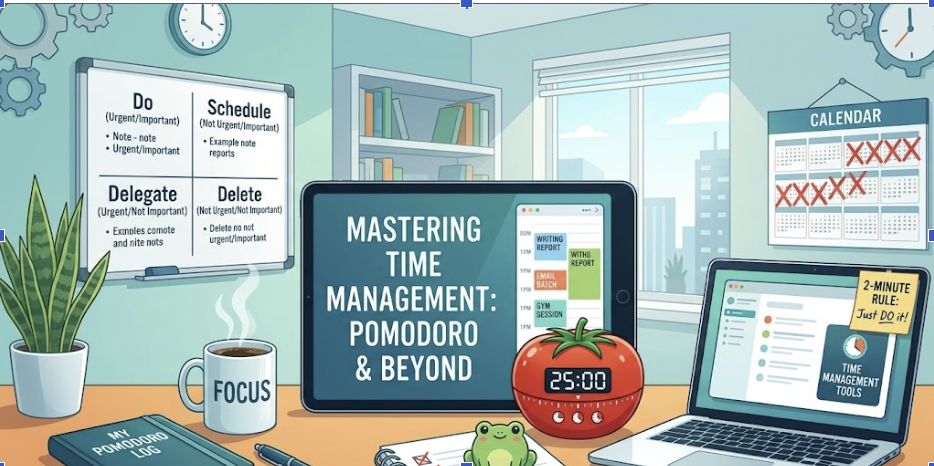
Have you ever sat down at your desk with a giant cup of coffee and a heart full of ambition only to look up at the clock and realize three hours have vanished into thin air? You probably spent those hours scrolling through social media, answering a few random emails, or organizing your digital folders instead of doing the actual work you needed to do. Do not worry because you are not alone in this struggle. The modern world is literally designed to steal our attention. Whether you are a busy executive working in a bustling skyscraper in New York City, a creative freelancer sipping lattes in a local cafe in Paris, or a student trying to study in a quiet suburban bedroom, the battle against distraction is universal. People everywhere are constantly searching local directories for productivity workshops near me or asking digital assistants questions to solve this exact problem. If you have ever asked a search engine "What is the best time management strategy?" or "How can I stop procrastinating right now?", you have landed in the perfect place. Answer Engine Optimization or AEO relies on answering these exact questions directly. The answer is not just about trying harder or drinking more coffee. The real secret lies in adopting proven systems that trick your brain into focusing. Today we are going to dive deep into the fascinating world of productivity. We will start with the incredibly famous Pomodoro technique and then journey far beyond it into other highly effective methods that can completely transform how you handle your daily schedule. Get ready to reclaim your hours, lower your stress levels, and finally conquer your massive to do list.
Mastering Time Management Techniques Pomodoro and Beyond
Have you ever sat down at your desk with a giant cup of coffee and a heart full of ambition only to look up at the clock and realize three hours have vanished into thin air? You probably spent those hours scrolling through social media, answering a few random emails, or organizing your digital folders instead of doing the actual work you needed to do. Do not worry because you are not alone in this struggle. The modern world is literally designed to steal our attention. Whether you are a busy executive working in a bustling skyscraper in New York City, a creative freelancer sipping lattes in a local cafe in Paris, or a student trying to study in a quiet suburban bedroom, the battle against distraction is universal. People everywhere are constantly searching local directories for productivity workshops near me or asking digital assistants questions to solve this exact problem.
If you have ever asked a search engine "What is the best time management strategy?" or "How can I stop procrastinating right now?", you have landed in the perfect place. Answer Engine Optimization or AEO relies on answering these exact questions directly. The answer is not just about trying harder or drinking more coffee. The real secret lies in adopting proven systems that trick your brain into focusing. Today we are going to dive deep into the fascinating world of productivity. We will start with the incredibly famous Pomodoro technique and then journey far beyond it into other highly effective methods that can completely transform how you handle your daily schedule. Get ready to reclaim your hours, lower your stress levels, and finally conquer your massive to do list.
What Are The Best Time Management Techniques?
When we talk about the best time management techniques, we are referring to structured frameworks that help you decide what to do and exactly when to do it. These methods prevent you from feeling overwhelmed by breaking massive projects into bite sized pieces. They also help you prioritize tasks so you are actually moving the needle on your goals instead of just spinning your wheels on busywork. Let us explore the most powerful tools available to you.
The Pomodoro Technique A Tomato Shaped Miracle
If you have ever dipped your toes into the ocean of productivity advice, you have almost certainly heard of the Pomodoro technique. Developed in the late nineteen eighties by a university student named Francesco Cirillo, this method is beautifully simple and incredibly effective. Cirillo was struggling to focus on his studies, so he grabbed a kitchen timer shaped like a tomato. The Italian word for tomato is pomodoro. He set the timer for a short duration and committed to working without any interruptions until it rang.
Here is exactly how you can implement the Pomodoro method in your own life today.
Choose a single task you want to accomplish. It could be writing a blog post, studying for an exam, or coding a new feature.
Set a timer for twenty five minutes. This twenty five minute block of pure focus is called one Pomodoro.
Work on the task until the timer rings. Do not check your phone. Do not look at your email. If a random thought pops into your head, write it down on a piece of paper to deal with later and immediately return to the task.
When the timer goes off, take a short break of exactly five minutes. Stand up, stretch, grab a glass of water, or simply rest your eyes.
After you complete four consecutive Pomodoros, you get to take a much longer break. This longer break should last between fifteen and thirty minutes.
Why does this funny little tomato timer system work so well? It all comes down to psychology. A massive project feels terrifying to the human brain. Your brain looks at a ten thousand word essay and wants to run away and hide. However, your brain can easily handle the idea of working for just twenty five minutes. By shrinking the commitment, you eliminate the friction of getting started. Furthermore, the frequent breaks prevent mental fatigue and keep your mind fresh and creative throughout the entire day.
Beyond The Tomato Discovering The Eisenhower Matrix
While the Pomodoro system is amazing for execution, it does not actually tell you what you should be working on in the first place. This is where the Eisenhower Matrix steps into the spotlight. Named after Dwight D Eisenhower, a former President of the United States known for his incredible efficiency, this tool is designed to help you prioritize your tasks based on their true importance.
Imagine a square divided into four smaller boxes. These boxes are your quadrants of productivity.
Quadrant One contains tasks that are Urgent and Important. These are the fires you need to put out immediately. Examples include a server crashing, a crying baby, or a looming deadline for a major client. You must do these tasks right now.
Quadrant Two contains tasks that are Important but Not Urgent. This is the magic zone. This quadrant includes strategic planning, exercising, learning new skills, and building relationships. You must schedule these tasks and fiercely protect the time you allocate to them.
Quadrant Three contains tasks that are Urgent but Not Important. These are the tricky interruptions that steal your time. Think of most ringing phones, trivial emails, or coworkers stopping by your desk to chat. You should try to delegate these tasks to someone else if possible.
Quadrant Four contains tasks that are Not Urgent and Not Important. These are pure time wasters. Endlessly scrolling through social media, watching mindless television, or organizing your junk drawer fall into this category. You should eliminate these activities from your workday entirely.
By filtering your daily to do list through the Eisenhower Matrix, you will quickly realize that you might be spending way too much time in quadrant three and quadrant four. The ultimate goal of a highly productive person is to spend as much time as possible residing entirely within quadrant two.
Time Blocking Making Your Calendar Your Boss
If you want to take your productivity to an elite level, you need to explore time blocking. This is the preferred method of highly successful executives and visionary entrepreneurs across the globe. Instead of keeping a list of things to do and hoping you find the time to do them, time blocking requires you to assign a specific job to every single minute of your day.
Here is how you can master the art of time blocking.
Open your digital calendar or a blank piece of paper.
Block out the absolute non negotiable parts of your day first. This includes sleeping, eating meals, and commuting.
Look at your prioritized tasks and assign them to specific time slots in your calendar.
Group similar tasks together. This is called batching. For example, instead of checking your email twenty times a day, create a one hour block in the morning and a one hour block in the afternoon specifically dedicated to processing emails.
Treat these calendar blocks as unbreakable promises to yourself. If you have a block scheduled from two oclock to four oclock for writing a report, you must treat that block with the exact same respect you would give to a meeting with your most important client.
Time blocking is incredibly powerful because it forces you to confront the reality of how much time you actually have. We often overestimate what we can accomplish in a single day. When you are forced to visually map out your tasks on a calendar, you become much more realistic about your capabilities. This prevents burnout and ensures that your most critical projects actually receive the focused attention they deserve.
Eat The Frog Conquering Your Worst Task First
Mark Twain famously said that if the first thing you do each morning is to eat a live frog, you can go through the rest of the day with the satisfaction of knowing that it is probably the worst thing that is going to happen to you all day. In the world of time management, your frog is your biggest, ugliest, and most important task. It is the task you are most likely to procrastinate on because it is difficult, boring, or intimidating.
The Eat the Frog technique is beautifully aggressive. It demands that you identify your frog the night before. Then, the very next morning, before you check your email, before you read the news, and before you attend any meetings, you sit down and tackle that massive task.
Identify the most critical task on your plate.
Prepare your workspace the night before so there is zero friction in the morning.
Wake up and immediately start working on the frog. Do not allow yourself to do anything else until it is finished.
When you successfully eat your frog first thing in the morning, you experience a massive rush of endorphins. You build incredible momentum that carries you through the rest of your workday. Even if the rest of your day is a complete disaster filled with interruptions and emergencies, you can still go to sleep that night knowing you accomplished your most vital objective.
The Two Minute Rule A Cure For Procrastination
Sometimes the biggest obstacle to productivity is simply the accumulation of tiny, annoying tasks. These micro tasks clutter your mind and create a low level hum of anxiety. This is where the Two Minute Rule, popularized by productivity expert David Allen, becomes an absolute lifesaver.
The rule is incredibly straightforward. If a task takes less than two minutes to complete, you must do it immediately. You do not write it down on a list. You do not schedule it for later. You simply execute it right then and there.
Replying to a quick text message takes less than two minutes. Do it now.
Putting your dirty coffee mug in the dishwasher takes less than two minutes. Do it now.
Filing a digital document into the correct folder takes less than two minutes. Do it now.
By ruthlessly applying the Two Minute Rule, you prevent small tasks from snowballing into overwhelming mountains of chores. It clears your mental workspace and allows you to dedicate your heavy cognitive energy to the big projects that actually matter.
The Seinfeld Strategy The Power Of Consistency
Comedian Jerry Seinfeld used a brilliant visual strategy to ensure he wrote new jokes every single day. He hung a giant calendar on his wall. Every day that he sat down and wrote new material, he drew a massive red cross over that date. After a few days, he had a chain of red crosses. His only goal from that point forward was simple. Do not break the chain.
You can apply the Seinfeld Strategy to any long term goal or habit you want to build. Whether you are trying to learn a new language, exercise daily, or write a novel, consistency is far more important than intensity.
Get a large visual calendar and place it somewhere you will see it every day.
Define the daily action you need to take. Keep it incredibly small to ensure you can do it even on your worst days.
Mark the calendar every time you complete the action.
Focus entirely on extending the visual chain.
The psychological pressure of not wanting to see a blank space on your beautiful chain of progress is a phenomenal motivator. It pushes you to show up and do the work, even when you feel tired or uninspired.
Creating Your Ultimate Personal Productivity System
The most important thing to understand about all these methods is that you do not have to choose just one. The most effective professionals in the world combine these strategies to create a customized personal productivity system that perfectly matches their unique brain chemistry and lifestyle.
For example, you might use the Eisenhower Matrix on Sunday evening to plan your upcoming week. You might identify your most important quadrant two tasks. Then, you could use Time Blocking to assign specific days and hours to those vital tasks. When Monday morning arrives, you might look at your calendar, identify your biggest frog, and use the Pomodoro technique to execute that task in twenty five minute sprints. Throughout the entire day, you can apply the Two Minute Rule to instantly eliminate any tiny distractions that pop up.
Search Engine Optimization experts always talk about finding the right keywords, but in the realm of personal growth, the real optimization is finding the right combination of habits. Whether you are searching for the best productivity apps on your phone or attending a local seminar near you, remember that tools are only as good as the consistency of the person using them.
Conclusion
Managing your time effectively is not about becoming a robotic machine that works twenty four hours a day without any joy. It is actually the exact opposite. By utilizing techniques like the Pomodoro method, the Eisenhower Matrix, Time Blocking, and the Eat the Frog strategy, you become significantly more efficient during your working hours. This newfound efficiency means you can actually log off at the end of the day without feeling totally guilty. You can spend more quality time with your family, pursue your hobbies passionately, or simply relax without the heavy burden of unfinished tasks weighing down your mind.
Start small. Pick just one technique from this blog post and try it out tomorrow morning. Set a tomato shaped timer for twenty five minutes and see what happens. You might be completely shocked by how much you can accomplish when you finally decide to take control of your attention. Time is the single most valuable resource you possess in this life because it is the only thing you can never buy more of. Guard it fiercely, spend it wisely, and watch as your productivity and your peace of mind soar to incredible new heights.
Need help making the right career decision?
Explore KickStartX career counselling and education guidance services for personalised support, scientific assessments, and structured career planning.
Explore related KickStartX services
Continue from this topic to the most relevant counseling, admission, abroad studies, skills, and career pathway pages.