The Art of Asking: Mastering Prompt Engineering Skills
Have you ever tried to have a complex, nuanced conversation with your phone’s digital assistant? It usually ends with you shouting "NO, I SAID 'CANCEL THE RESERVATION,' NOT 'ORDER CONSOLATION PIZZA!'" The experience is less "Blade Runner" and more "screaming into a void of miscommunication." Now, enter the new generation of Artificial Intelligence, those sophisticated Large Language Models (LLMs) like ChatGPT, Claude, and Gemini. They are infinitely more powerful, creative, and potentially helpful. Yet, many people approach them, type in a five word sentence, get back a mediocre answer, and walk away thinking, "Well, the robots aren't taking my job yet."
The Art of Asking: Mastering Prompt Engineering Skills
Have you ever tried to have a complex, nuanced conversation with your phone’s digital assistant? It usually ends with you shouting "NO, I SAID 'CANCEL THE RESERVATION,' NOT 'ORDER CONSOLATION PIZZA!'" The experience is less "Blade Runner" and more "screaming into a void of miscommunication." Now, enter the new generation of Artificial Intelligence, those sophisticated Large Language Models (LLMs) like ChatGPT, Claude, and Gemini. They are infinitely more powerful, creative, and potentially helpful. Yet, many people approach them, type in a five word sentence, get back a mediocre answer, and walk away thinking, "Well, the robots aren't taking my job yet."
The problem usually is not the AI. It is you. Or rather, it is how you are talking to it.
We are living through a fundamental shift in how we interact with technology. For decades, we learned the machine language. We memorized menu commands, we learned keyboard shortcuts, and we mastered the very specific keywords required to wring good results out of a Google search. We bent our human way of thinking to accommodate the literal, rigid logic of the computer.
But with generative AI, the paradigm has flipped. The machine has learned our language. It reads our essays, summarizes our meetings, and writes our poetry. The barrier to entry has evaporated, leading many to believe that "talking" to AI requires no special skills.
This is the central myth of the AI age. The truth is, while anyone can start a conversation with AI, very few people know how to finish one with exactly what they needed.
This gap, the space between a simple typed command and a truly great result, is filled by a single emerging superpower: Prompt Engineering.
This is not "coding" in the traditional sense. You do not need to understand Python or neural networks. Prompt engineering is a new kind of literacy. It is the sophisticated intersection of writing, critical thinking, logic, and a bit of performance art. It is the art of telling a very powerful, very literal, very knowledgeable assistant exactly what you want, when you want it, and how you want it presented, without leaving room for error.
If you are ready to stop yelling at your digital assistant and start commanding an army of artificial intelligence, it is time to upgrade your vocabulary and learn the skills of prompt engineering.
Understanding Your Conversation Partner: AI is Not Your Coworker
The first mistake most people make is treating the AI like an extremely well educated person who just happened to be in the room. You assume it has context. You assume it understands social norms. You assume it can infer what you meant rather than what you actually typed. These are dangerous assumptions.
AI models are incredibly advanced pattern matching engines. They have ingested a massive portion of the internet and understand the statistical relationships between words and ideas. They are not thinking; they are predicting. They are predicting, based on everything they have ever read, what the absolute best next sentence should be given the current sentence you just typed.
This makes them powerful, but it also makes them incredibly literal. They will not correct your assumptions. They will not stop and say, "Wait, that seems illogical." They will, most of the time, faithfully obey your command, even if that command is nonsensical, biased, or leads them off a rhetorical cliff.
Prompt engineering is the antidote to that literalism. It is the practice of providing all the necessary context, boundaries, constraints, and instructions required for the AI to "predict" the correct answer, not just any answer.
The Anatomy of a Perfect Prompt: The Five Elements of Success
A basic prompt is like shouting "Food!" into a restaurant kitchen. You might get a perfectly cooked steak, or you might get a bowl of lukewarm tapioca pudding. A skilled prompt engineer knows how to provide the full recipe, the plating instructions, and the nutritional requirements in one go.
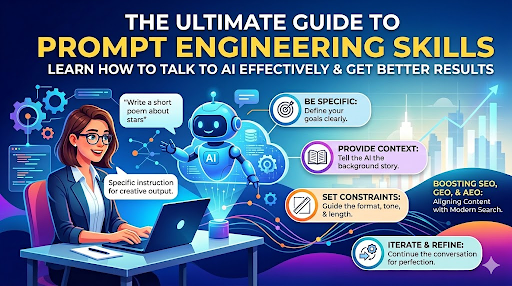
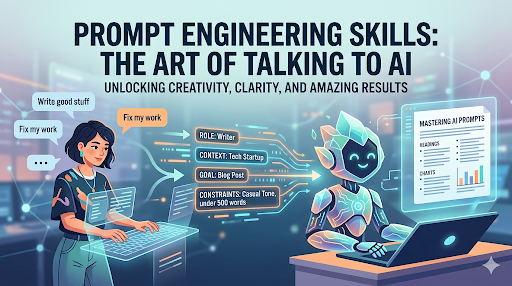
Think of every prompt as a small engineering project. You need blueprint, raw materials, and specific performance specifications. A great, robust, highly functional prompt almost always includes these five essential elements:
Role (The "Who"): AI models are natural chameleons. They can adopt almost any persona. By default, they are helpful, bland assistants. But if you tell them to act as a "seasoned digital marketing director with fifteen years of experience in the SaaS space," the entire tone, depth, and sophistication of their response changes. Suddenly, they are referencing specific key performance indicators, understanding complex marketing funnels, and using industry jargon correctly. You have given them a lens through which to filter their infinite knowledge.
Task (The "What"): This is the core instruction. It must be a crystal clear, action oriented verb. "Analyze the data," "Write an email," "Summarize this article," or "Debug this code." Avoid vague tasks like "help me understand..." Be as precise as possible. Instead of "Summarize this text," use "Extract the five most critical takeaways and two major counterarguments from the following text."
Context (The "Why" and "With What"): This is where most prompts fail. The AI is starting with a clean slate. You must provide the background information needed to complete the task successfully. If you want the AI to write a marketing email, the "context" is not just "it is for a new app." It is: "Our ideal customer is a busy middle manager who struggles with time tracking. We want to emphasize how our app saves them two hours a week. The company values are simplicity and innovation." Without context, the AI will default to the most generic, least persuasive content possible.
Constraints (The "How"): This element defines the boundaries. You are not giving the AI permission to hallucinate freely; you are building a fence. Constraints are crucial for quality control. They include instructions like:
"Do not use marketing buzzwords."
"Keep the summary under 150 words."
"Format the output as a bulleted list followed by a summary."
"Only base the answer on the provided text; do not use external information."
"Avoid using any compound adjectives like 'game changing' or 'thought provoking'." (This one is particularly important for this assignment!)
Format (The "What next"): How do you want the final output to appear? AI can generate essays, poems, code, marketing copy, social media posts, tables, graphs, HTML, JSON code, or even ASCII art. Tell it exactly how to present the information. A simple instruction like "Format the output as a Markdown table with three columns: Topic, Key Insight, and Action Item" saves you ten minutes of manual formatting work.
An Example: From Average to Awesome
Let us look at how these elements transform a request.
Average, five word prompt:
"Write a fun social media post about our new company coffee machine."
The inevitable average result:
"Hey everyone! We got a brand new coffee maker in the breakroom! It is the latest model and is super fancy. Come down and grab a cup to fuel your afternoon! #CoffeeTime #OfficeLife #NewGear"
This is fine. It is correct. It is also unimaginably boring. It looks like it was written by a committee that met once, approved the use of two standard hashtags, and then went home early.
Now, let us use the Five Elements of Prompt Engineering:
"Act as a witty, casual brand copywriter for a young tech startup. The task is to write one highly engaging, funny post for Instagram (under 100 words) about our new office coffee machine. This coffee maker is famous for being incredibly complex and making espresso that is so strong it is practically illegal. The tone should be slightly self deprecating about our coffee addiction and should encourage engagement. Do not use corporate clichés like 'game changing' or 'synergy.' End with a question asking the team which ridiculous feature they are most excited to try first."
The new, robust result:
"Okay team, the rumors are true. We didn’t just get a new coffee maker; we acquired a sentient, twelve step espresso laboratory. It requires three security clearances and a PhD in thermodynamics to operate, but it produces rocket fuel that will probably allow us to complete an entire quarter’s worth of roadmap in a single afternoon. Who is brave enough to try the 'Dark Matter Extraction' setting first? Tell us below. 🚀☕️"
The second post is vastly superior. It has personality. It understands the context of a tech startup. It obeys the negative constraints by avoiding corporate clichés. Most importantly, it gets users to interact with it, which is the primary goal of social media.
The Secret to Advanced Prompts: It is an Iterative Dialogue
Prompt engineering is not a single act. You are rarely done after the first input. The true skill lies in the conversation that follows.
This is the process of iteration. You should never accept the AI’s first output as the definitive answer. Treat that first result as a rough draft, a baseline to improve upon.
Let us say you asked the AI to write a three hundred word article about the benefits of mediation for beginners. It gives you a passable, slightly dry result. A rookie prompt engineer would copy/paste that result and be done. A master prompt engineer begins the refinement process:
Refine Tone: "This is too academic. Rewrite it, but this time use the voice of an encouraging, empathetic mindfulness coach."
Adjust Format: "The structure is weak. Break this into three distinct sections: The 'What,' the 'Why,' and a simple 'How To' step by step guide."
Add Substance: "The benefits section is generic. Add specific, scientifically proven benefits like 'reduced cortisol levels' and 'improved cognitive flexibility,' but explain them using simple language."
Critique and Polish: "Now, reread the entire piece. Find any weak, passive sentences and make them active and punchy. Ensure that you do not use any hyphens."
By having this iterative dialogue, you are guiding the model. You are chipping away the generic fluff until only the highly relevant, high quality content remains. You are acting as the editor in chief, and the AI is your extremely fast, endlessly patient, albeit slightly literal, junior writer.
Key Advanced Techniques to Level Up
Once you understand the basic components, you can begin to use more advanced prompting "recipes" that give the AI a significant cognitive boost.
Few Shot Prompting: AI is brilliant at pattern matching. Instead of just telling the AI what you want, you show it. Give it two or three examples of input and the corresponding desired output before you give it your actual request. For example, if you want it to classify customer emails as 'Complaints,' 'Inquiries,' or 'Praise,' first provide examples:
Example 1 Input: "Your product is completely broken, and I want a refund." / Output: Complaint.
Example 2 Input: "Does this come in blue?" / Output: Inquiry.
Your Real Input: "I just wanted to say I love the new feature update!" / (The AI will correctly output Praise). This technique is incredibly powerful for complex classifying or formatting tasks.
Chain of Thought (CoT): This is one of the single most effective ways to improve the quality of AI logic, especially for math problems, coding, or complex reasoning. By default, the AI gives you the answer. But if you tell it, "Think through this problem one step at a time," or simply add "Before giving the final answer, show your entire reasoning process step by step," the accuracy jumps dramatically. The AI must vocalize (or "reason") its own internal process, which helps it to avoid making the kind of logical leaps that lead to hallucinations or errors.
Prompting the AI to be its Own Critic: This is a meta engineering technique. After you get an output, ask the AI to evaluate its own work before presenting it. Ask it, "Read your previous response. Critique it for tone, logical inconsistencies, and completeness. What are the three biggest flaws in that argument? Now, rewrite the response using that critique to make it 50% more persuasive." You are essentially creating a recursive loop where the AI’s own "thought process" is used as a new input for improvement.
A New Chapter in Human Communication
Prompt engineering has been called "the closest thing we have to magic," and there is truth in that. It is the practice of using words to manipulate logic and information at a scale previously unimaginable.
But we are still at the early, awkward stage of this new chapter. These models are constantly evolving. The techniques that worked six months ago may already be outdated. Large language models are increasingly learning from the context of your conversation history, reducing the need for lengthy initial prompts.
Yet, the core, underlying skill will not change. It is not about knowing the perfect "magic words" to unlock a hidden menu. The true skill of prompt engineering is human clarity.
It forces you to be precise. It requires you to structure your thoughts logically. It demands that you think critically about what you actually want and how that information should be communicated. If you cannot explain your problem to a slightly dense but extraordinarily well read junior intern, you probably cannot explain it to an AI, either.
Prompt engineering is not about learning to code; it is about learning to communicate with crystalline clarity. It is the ultimate tool for amplifying human intent, turning a vague idea into a finished product in seconds rather than days. So, stop talking to AI. Start engineering your conversations. The results will be anything but robotic.
Conclusion
The rise of artificial intelligence has not made communication less important; it has made it more critical than ever before. We are no longer limited by how fast we can type or how many lines of code we can write. The only true limit now is the clarity of our own thinking and our ability to translate that thought into a precise set of instructions. Prompt engineering is not a passing trend or a niche skill for tech enthusiasts. It is the language of the future, a necessary literacy for anyone who wants to not only navigate but thrive in the age of intelligent machines. The superpower you have been waiting for is already in your hands, or more accurately, your vocabulary. You just need to learn how to use it.
Need help making the right career decision?
Explore KickStartX career counselling and education guidance services for personalised support, scientific assessments, and structured career planning.
Explore related KickStartX services
Continue from this topic to the most relevant counseling, admission, abroad studies, skills, and career pathway pages.