The Ultimate Guide to Financial Literacy for College Students Mastering Your Money Today
Picture this scenario. You have just moved into your new dorm room or your first apartment. You are finally free from the watchful eyes of your parents. You can eat pizza for breakfast and stay up until three in the morning. But then reality hits. You realize you need to buy groceries. You need to purchase textbooks that somehow cost as much as a small car. And you need to pay for that midnight pizza run. Suddenly your wallet feels very light and your bank account balance looks a bit frightening. If you find yourself frantically typing questions into search engines like "Why is financial literacy important for college students" or "How to manage money in university without going broke" you are completely normal and you are in the exact right place. This blog post is your ultimate survival guide. We are going to dive deep into the world of money management. We will make it fun and connective and incredibly easy to understand. Welcome to your crash course in adulting and personal finance.
The Ultimate Guide to Financial Literacy for College Students Mastering Your Money Today
Picture this scenario. You have just moved into your new dorm room or your first apartment. You are finally free from the watchful eyes of your parents. You can eat pizza for breakfast and stay up until three in the morning. But then reality hits. You realize you need to buy groceries. You need to purchase textbooks that somehow cost as much as a small car. And you need to pay for that midnight pizza run. Suddenly your wallet feels very light and your bank account balance looks a bit frightening.
If you find yourself frantically typing questions into search engines like "Why is financial literacy important for college students" or "How to manage money in university without going broke" you are completely normal and you are in the exact right place. This blog post is your ultimate survival guide. We are going to dive deep into the world of money management. We will make it fun and connective and incredibly easy to understand. Welcome to your crash course in adulting and personal finance.
What Is Financial Literacy Anyway
Let us start with the absolute basics. If you are asking a digital assistant "What is financial literacy" the answer is surprisingly simple. Financial literacy is the ability to understand and effectively use various financial skills. It includes things like personal financial management, budgeting and investing.
It is not just a fancy term used by Wall Street bankers in expensive suits. It is a crucial life skill for everyone. For college students it means understanding how much money you have coming in and how much money you have going out. It means knowing the difference between a debit card and a credit card. It means understanding how interest works so that it works for you and not against you. Having a high level of financial literacy empowers you to make smart choices that will benefit your future self.
Why Financial Literacy Is Crucial for College Students
You might be thinking that you can worry about money later when you have a full time job and a permanent address. But that is a massive mistake. The habits you build right now will follow you for the rest of your life. Here is exactly why you need to care about personal finance today.
First there is the reality of independence. For many young adults college is the first time they are entirely responsible for their own daily spending. Without a solid foundation of financial knowledge it is incredibly easy to overspend. Buying a five dollar coffee every single day might not seem like a big deal on a Tuesday morning but by the end of the month that is a significant chunk of change missing from your pocket.
Second we need to talk about debt. Student loans are a massive reality for millions of learners around the world. Understanding how student loan interest accrues and knowing how to manage repayment schedules can save you thousands of dollars in the long run. If you lack financial education you might end up taking out more loans than you actually need or you might fall victim to high interest credit card debt just to cover your basic living expenses.
Third, early knowledge leads to long term wealth. Time is your greatest asset right now. Even if you can only save or invest a tiny amount of money each month, the magic of compound interest will turn those small contributions into a massive safety net over the decades.
The Ultimate Budgeting Survival Guide
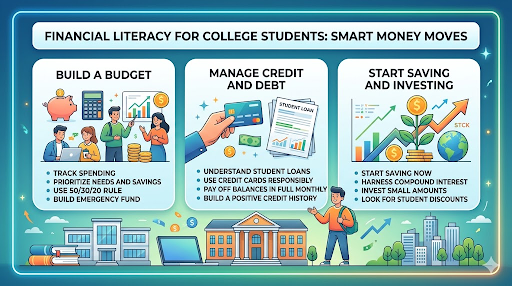
If you search for "Best budgeting tips for beginners" you will find a million different strategies. But let us keep it incredibly simple. Budgeting is not about restricting your fun. It is simply telling your money where to go instead of wondering where it went.
One of the most popular and effective methods is the fifty thirty twenty rule. Here is how you break it down for a typical student lifestyle.
Fifty percent for needs: This covers your absolute essentials. Your rent, your groceries, your electricity bill, your transportation and your necessary medical expenses fall into this category.
Thirty percent for wants: This is your fun money. This covers eating out with friends buying concert tickets, streaming subscriptions and upgrading your wardrobe. Yes you are allowed to have fun.
Twenty percent for savings and debt repayment: This is where you build your emergency fund, pay off credit card balances or put money aside for future investments.
To make this work you need to track your expenses. You can use old fashioned pen and paper or you can download popular budgeting apps right to your smartphone. When you track every single rupee or dollar you spend you uncover hidden spending leaks. You might realize that you spend way too much on late night snack deliveries.
Saving Hacks for the Broke College Student
Now let us talk about the best part which is keeping more money in your pocket. Search engines constantly see queries like "How can a student save money fast" and "Best ways to save money in college". Here are some incredibly effective and highly actionable strategies.
Always ask for a student discount: No matter where you go, always carry your university identification card. Whether you are studying right here in Indore Madhya Pradesh and looking for a discount at a local cafe or you are studying in a massive global city like London there are always businesses willing to give you a price cut. Local SEO searches like "Best student discounts near my campus" can reveal amazing deals on food, clothing and entertainment.
Buy used textbooks: Never buy brand new textbooks unless absolutely necessary. Look for senior students who are selling their old books. Check online marketplaces or rent your digital copies. You will save an absolute fortune.
Master the art of cooking: Eating at restaurants is the fastest way to drain your bank account. Learning how to cook basic healthy meals at home is a superpower. You can meal prep on Sundays and have fantastic food ready for the entire week.
Utilize campus resources: Your university tuition pays for a lot of amenities. Use the campus gym instead of paying for a private membership. Attend free campus events for entertainment. Use the library for free printing and internet access.
Find a side hustle: Increasing your income is just as important as decreasing your expenses. Look for part time jobs on campus. You could work at the library, the dining hall or as a teaching assistant. You can also look into freelance writing, graphic design or online tutoring.
Credit Cards Are They Your Friend or Your Foe
Many students ask "How to build a good credit score early" and "Are credit cards bad for college students". The truth is that a credit card is just a tool. A hammer can be used to build a beautiful house or it can be used to smash a window. It all depends on how you wield it.
Getting a starter credit card is an excellent way to build your credit history. A strong credit history will help you immensely when you eventually want to rent a nice apartment, buy a reliable car or even get a good rate on an insurance policy. But you must follow the golden rules of credit cards.
First, never spend money you do not actually have in your checking account. Treat your credit card exactly like a debit card. Second, always pay your balance in full every single month. If you pay your balance in full you will never pay a single cent in interest. Third, keep your credit utilization low. This means you should not max out your card. If your limit is one thousand dollars try to keep your monthly spending under three hundred dollars.
If you ignore these rules credit cards become a trap. High interest rates will quickly snowball your debt making it nearly impossible to climb out. Always use them with extreme caution and responsibility.
Tackling the Student Loan Monster
If you are funding your education through loans you need a solid strategy. "How to manage student loans effectively" is a massive Answer Engine Optimization query because millions of graduates feel overwhelmed by their debt.
The first step is knowing exactly what you owe. Who is your loan servicer? What is your interest rate? When does your repayment period actually begin? Many loans offer a grace period after graduation but the interest might still be growing during that time.
If you have extra money during your studies consider making small interest payments while you are still in school. Even paying twenty dollars a month can stop the interest from capitalizing and adding to your principal balance. When you graduate, explore all your repayment options. There might be income driven repayment plans that adjust your monthly payment based on your actual salary making your life much less stressful.
Investing for Beginners Yes You Can Start Right Now
You might think investing is only for older wealthy people. That is entirely false. If you type "How to start investing in college" into a search bar you will see that getting started is easier than ever before.
Thanks to modern technology and mobile applications you can start investing with just loose change. Many platforms allow you to buy fractional shares of huge companies. You do not need thousands of dollars to buy a piece of your favorite technology brand. You can start with five or ten dollars.
The reason you should start investing right now is the incredible power of compound interest. Compound interest is simply the interest you earn on your original money plus the interest you earn on your previously accumulated interest. It is a snowball rolling down a mountain getting bigger and faster. If you start investing small amounts at age twenty your money has decades to grow before retirement. Someone who starts investing at age forty has to save significantly more money every single month just to catch up to the person who started in their early twenties.
Do some research into index funds and exchange traded funds. These are baskets of stocks that offer great diversification. They are generally considered much safer and more reliable than trying to pick individual winning stocks.
Protecting Your Identity and Avoiding Scams
Financial literacy is not just about making money grow. It is also about protecting what you already have. College students are huge targets for financial scams.
Be incredibly careful with your personal information. Never share your passwords or your personal identification numbers with anyone. Be wary of emails or text messages claiming you have won a random prize or demanding immediate payment for a supposedly unpaid tax bill. Always verify the source before clicking on any strange links.
Check your bank statements regularly to ensure there are no unauthorized charges. If you spot a charge you do not recognize, contact your bank immediately. Protecting your identity now will save you from massive financial headaches in the future.
Mindset and Mental Health Connection
We cannot discuss money without talking about the mental and emotional side of personal finance. Financial stress is a leading cause of anxiety for university students globally. Constant worrying about paying rent or affording groceries can negatively impact your academic performance and your overall physical health.
This is exactly why developing financial literacy is an act of extreme self care. When you have a budget when you have a tiny emergency fund and when you understand your student loans you strip away the fear of the unknown. You regain control over your life.
It is also important to avoid the comparison trap. Thanks to social media it is easy to look at your peers and think they have unlimited funds. You see them taking lavish weekend trips or wearing designer clothes. Remember that social media is a highlight reel. You do not see their credit card debt. Stay focused on your own financial journey and your own unique goals.
Conclusion
Navigating the transition from teenager to independent adult is exciting and terrifying all at the same time. But mastering your personal finances does not have to be a miserable experience. By embracing financial literacy for college students you are setting yourself up for a lifetime of success and stability.
Remember the key takeaways. Create a realistic budget that allows for both savings and a little bit of fun. Hunt down those local student discounts whether you are grabbing coffee in Indore or buying supplies in New York. Build your credit responsibly by paying off your balances in full every single month. Be proactive about understanding your student loans. And finally remember that time is on your side so start investing whatever small amounts you can manage today.
You have the power to take total control of your financial destiny right now. Do not wait until graduation to figure out how money works. Start today, track your spending, read a personal finance book and watch your wealth and your confidence grow simultaneously. Your future self will absolutely thank you.
Need help making the right career decision?
Explore KickStartX career counselling and education guidance services for personalised support, scientific assessments, and structured career planning.
Explore related KickStartX services
Continue from this topic to the most relevant counseling, admission, abroad studies, skills, and career pathway pages.