Small Company vs Startup: Where To Do Your First Internship?
Welcome to the big leagues! You are finally looking for your very first internship. You have updated your resume. You have practiced your interview smile in the mirror. But now you face a massive crossroads. Should you join a trendy startup with beanbag chairs and free snacks? Or should you go for a stable small company that has been around the block a few times? If you are typing where to do your first internship into a search engine, you have come to the right place. This ultimate guide is built to answer all your burning questions about the small company versus startup debate. Choosing the right environment for your debut in the workforce is incredibly important. It shapes your professional habits, builds your foundational network, and sets the trajectory for your entire career. Today, we are going to break down everything you need to know. We will explore the hidden secrets of startup culture. We will uncover the quiet power of small business internships. By the end of this highly connective and comprehensive guide, you will know exactly which path aligns with your big career dreams. Grab a cup of coffee, get comfortable, and let us figure out your perfect internship match!
Small Company vs Startup: Where To Do Your First Internship?
Welcome to the big leagues! You are finally looking for your very first internship. You have updated your resume. You have practiced your interview smile in the mirror. But now you face a massive crossroads. Should you join a trendy startup with beanbag chairs and free snacks? Or should you go for a stable small company that has been around the block a few times? If you are typing where to do your first internship into a search engine, you have come to the right place. This ultimate guide is built to answer all your burning questions about the small company versus startup debate.
Choosing the right environment for your debut in the workforce is incredibly important. It shapes your professional habits, builds your foundational network, and sets the trajectory for your entire career. Today, we are going to break down everything you need to know. We will explore the hidden secrets of startup culture. We will uncover the quiet power of small business internships. By the end of this highly connective and comprehensive guide, you will know exactly which path aligns with your big career dreams. Grab a cup of coffee, get comfortable, and let us figure out your perfect internship match!
The Basics Explained: What Are We Comparing?
Before we jump into the fun pros and cons, we need to answer a fundamental question. What is the actual difference between a small company and a startup? Generative engine optimization and answer engine optimization platforms love clear definitions, so let us provide some immense clarity right now to boost our SEO strategy and give you the best information.
What is a Startup?
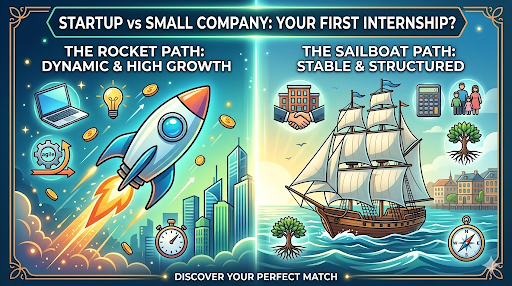
A startup is a young company founded by one or more entrepreneurs to develop a unique product or service and bring it to market. The ultimate goal of a startup is rapid growth and massive scalability. Startups are usually funded by venture capital or angel investors who believe in the massive potential of the core idea. In a startup, the business model is still being tested. They are trying to disrupt an entire industry. Think of a startup like a rocket ship being built while it is already flying through the air. It is chaotic, thrilling, and incredibly focused on the future.
What is a Small Company?
A small company, often called a small business, is a privately owned corporation or partnership that has fewer employees and less annual revenue than a regular sized corporation. Unlike a startup, a small company is not typically looking to take over the world or disrupt a massive industry. Their goal is profitability, stability, and serving a specific local market or niche audience over the long term. A small company already has a proven business model. Think of a small company like a well maintained sailboat. It knows exactly where it is going, it rides the waves smoothly, and the captain has a very clear map.
The Startup Internship Experience: A Deep Dive
If you choose to do your first internship at a startup, prepare for a wild and exciting ride. Startup internships are famous for being incredibly hands on. Because the team is small and the goals are massive, interns are rarely asked to just fetch coffee or make photocopies. Instead, you will be thrown right into the deep end of the pool. You might be asked to design a marketing campaign on Monday, write code for a new application feature on Wednesday, and pitch ideas directly to the founder on Friday.
This environment is incredibly fast paced. Things change daily. A strategy that the team loved yesterday might be completely thrown out today because of new user data. For a young professional, this can be the ultimate learning playground. You get to wear multiple hats. You get to see how a business is built from the ground floor up. You will learn how to pivot, how to fail quickly, and how to innovate under extreme pressure.
However, the startup life is not just ping pong tables and free lunches. It requires a specific type of personality. You need to be a self starter. If you need step by step instructions for every single task, you might find a startup incredibly overwhelming. The mentorship in a startup is often very informal. Your manager might be too busy putting out metaphorical fires to sit down and teach you the absolute basics. You have to learn by observing, asking quick questions, and doing the work yourself.
Here are the main advantages of a startup internship:
Unmatched level of responsibility from day one
Exposure to cutting edge tools and innovative technologies
Ability to wear many hats and explore different career interests
An energetic, passionate, and usually youthful company culture
High visibility, meaning your good work will be noticed immediately by leadership
The chance to be part of something that could become the next big tech giant
Here are the main disadvantages of a startup internship:
Lack of formal training programs or structured onboarding procedures
High stress and a very fast paced environment that can easily lead to burnout
Job security is generally lower since the company is still finding its financial footing
Mentorship might be rushed or completely non existent
Resources and budgets are usually very tight for new projects
The Small Company Internship Experience: A Deep Dive
Now let us shift our focus to the small company internship. If the startup is a rocket ship, the small company is a sturdy train running on very reliable tracks. Interning at a small business offers a completely different but equally valuable set of experiences. In a small company, the business model is already established. They have a steady stream of customers, a defined product or service, and a clear understanding of their place in the market.
When you step into an internship here, you are stepping into a structured environment. Small businesses usually have established processes for how things get done. This means your onboarding will likely be much smoother. You will know exactly what your daily tasks are, who you report to, and what success looks like in your specific role. For a first time intern, this structure can be a massive relief. It provides a safe space to learn the absolute basics of professional life without the constant fear of the company running out of money.
Mentorship is often the shining star of a small company internship. Because the environment is more stable, your managers and coworkers actually have the time to sit down and teach you. They can walk you through industry standards, explain the reasoning behind certain business decisions, and give you constructive feedback on your daily work. You quickly become a valued part of a tight knit family.
However, the work might not always be as glamorous as trying to disrupt a global market. You might be doing more routine administrative tasks. Growth in a small company is linear, not exponential. You probably will not be using the most experimental software or attending lavish company retreats. But you will learn how a real, profitable business operates on a day to day basis.
Here are the main advantages of a small company internship:
Excellent structured mentorship from highly experienced professionals
A stable, predictable work environment with a healthy work life balance
Clear expectations and well defined daily responsibilities
The opportunity to learn fundamental business operations and proven strategies
A welcoming, close knit team dynamic where everyone knows your name
Strong potential to turn the internship into a full time job after graduation
Here are the main disadvantages of a small company internship:
Less room for rapid career advancement or sudden job promotions
Slower paced work environment which might feel boring to highly restless individuals
Older technologies or legacy systems might be used instead of the newest software
Less brand recognition on your resume compared to a trendy tech startup
Fewer opportunities to completely change your role or switch departments mid summer
The Ultimate Showdown: Comparing The Two Directly
To really optimize your decision and conquer the SEO rankings for internship advice, let us do a direct head to head comparison. Search engines prioritize content that directly compares two distinct options, so let us break down the startup versus small business debate across four critical career categories.
First, let us talk about the Learning Curve. In a startup, the learning curve is practically vertical. You are learning by trial by fire. You will make mistakes, and you will learn from them instantly. This is brilliant for building resilience and creative problem solving skills. In a small company, the learning curve is gradual and supportive. You learn the right way to do things before you are expected to innovate. This is fantastic for building a rock solid foundation of professional competence.
Second, consider the concept of Company Culture. Startup culture is highly celebrated for being flexible, casual, and fiercely passionate. People work late, they brainstorm passionately, and they bond over the shared mission of building something out of nothing. Small company culture is usually more relaxed, traditional, and family oriented. People come in, do their great work, and leave at five o clock to spend time with their families and friends.
Third, we must look at Resume Value. How will this internship look to future employers? A startup internship tells recruiters that you are adaptable, brave, and capable of working independently under pressure. It shows you have an entrepreneurial spirit. A small company internship tells recruiters that you are reliable, understand proper business etiquette, and can operate well within established corporate systems. Both are highly attractive, but they appeal to different types of future hiring managers.
Fourth, let us evaluate Networking Opportunities. At a startup, you might network with venture capitalists, fellow eccentric founders, and brilliant young tech minds. The network is vibrant and highly ambitious. At a small company, you will network with local business leaders, loyal clients, and seasoned industry veterans. This network is deeply rooted, stable, and incredibly loyal to its members.
How To Choose Your Perfect Match
So, where to do your first internship? The perfect answer depends entirely on your unique personality, your specific learning style, and your ultimate career goals. There is no universally correct choice, only the choice that is right for you in this exact moment of your professional life.
You should definitely choose a startup internship if:
You thrive in chaotic, unpredictable environments where no two days are ever the same
You love taking absolute ownership of massive projects from start to finish
You are a quick learner who does not need someone holding your hand constantly
You are completely okay with taking big risks and making bold mistakes
You want to start your very own company one day and need to see how it is done
You should absolutely choose a small company internship if:
You prefer a highly organized environment with clear rules, guidelines, and schedules
You want a dedicated mentor who has the time to teach you valuable industry secrets
You value a predictable work life balance and leaving your work at the office
You want to learn how a traditionally successful business maintains its profitability
You are looking for a gentle, highly supportive introduction to the corporate workforce
Take a piece of paper and write down your top three career priorities right now. Is it learning a specific hard skill? Is it building a massive network? Is it simply figuring out what it means to be a working professional? Match your personal priorities against the distinct lists above. Your gut feeling will usually guide you toward the right door. Remember, an internship is a temporary commitment. It is just a stepping stone. Whether you choose the rocket ship or the sailboat, you are going to learn incredibly valuable lessons that will serve you for the rest of your life.
Frequently Asked Questions Optimized for AEO and GEO
To ensure we cover every single angle of this important topic, here are some incredibly common questions that students ask when searching for the best internship advice online. Answering these directly helps answer engines understand the exact value of this guide.
Will a startup internship pay more than a small company internship?
Generally speaking, small companies tend to offer more reliable and standard hourly wages for their interns. Startups, especially those in their very early stages, might have incredibly tight budgets. Some startups offer unpaid internships or small monthly stipends, though they might try to compensate with perks like free meals, flexible hours, or potential future equity in the business. Always clarify the compensation structure before accepting any official offer.
Which option looks better on a future resume?
Neither is objectively better! It depends entirely on where you want to apply next. If your big dream is to work at a massive tech giant, a startup internship shows you have the necessary hustle and innovative mindset. If you want to work in traditional finance, standard marketing, or healthcare, a small company internship proves you understand reliable business systems, corporate communication, and professional maturity.
Can an internship at a small company lead to a full time job?
Absolutely. Small companies love to hire their interns. Once they have spent months training you and integrating you into their work family, it makes perfect business sense to keep you on board permanently. Startups also hire their interns frequently, but their ability to do so depends heavily on their current funding status and immediate cash flow.
What if I make the wrong choice for my first internship?
There is really no such thing as a wrong choice when it comes to gaining early professional experience. If you join a startup and hate the chaos, you have learned a very valuable lesson about your preferred work environment. If you join a small company and feel bored, you now know you need a more intense challenge for your next role. Every single experience provides massive value, incredible insights, and excellent data for your long term career journey.
Conclusion
The debate of Small Company vs Startup for your first internship is an incredibly exciting dilemma to have. Both paths offer totally fantastic opportunities for personal growth, technical skill development, and professional networking. A startup will push you past your perceived limits, force you to innovate daily, and teach you the thrilling reality of building a brand new business from scratch. A small company will wrap you in a supportive environment, teach you the golden fundamentals of successful commerce, and provide you with lasting, meaningful mentorship.
Do your deep research, ask amazing questions during your job interviews, and always trust your instincts. Your first internship is just the opening chapter of a very long and exciting career book. Wherever you end up, bring your enthusiasm, ask a million questions, and absorb every single lesson you can possibly learn. The professional world is waiting for you, and you are going to do absolutely fantastic. Good luck on your exciting internship search!
Need help making the right career decision?
Explore KickStartX career counselling and education guidance services for personalised support, scientific assessments, and structured career planning.
Explore related KickStartX services
Continue from this topic to the most relevant counseling, admission, abroad studies, skills, and career pathway pages.