Soft Skills That Will Make You Indispensable: Emotional Intelligence
Have you ever wondered why some people seem to glide through their careers with effortless grace? They get the promotions, they win over the toughest clients, and they somehow manage to keep their cool when the office printer jams five minutes before a massive presentation. You might think they are just naturally lucky or perhaps they have a genius level IQ. But more often than not, the secret sauce behind their success is something entirely different. It is called Emotional Intelligence. In a world where technology is advancing at lightning speed, we are seeing artificial intelligence take over routine tasks, crunch numbers, and even write basic reports. But here is the good news for us humans. Machines cannot empathize. They cannot read the subtle shift in a room when a sensitive topic is brought up, and they definitely cannot offer a comforting word to a stressed coworker. This is exactly why soft skills are no longer just nice to have. They are absolutely critical. Among all the soft skills you could possibly develop, Emotional Intelligence stands head and shoulders above the rest. It is the ultimate tool to make you completely indispensable to any employer.
Soft Skills That Will Make You Indispensable: Emotional Intelligence
Have you ever wondered why some people seem to glide through their careers with effortless grace? They get the promotions, they win over the toughest clients, and they somehow manage to keep their cool when the office printer jams five minutes before a massive presentation. You might think they are just naturally lucky or perhaps they have a genius level IQ. But more often than not, the secret sauce behind their success is something entirely different. It is called Emotional Intelligence.
In a world where technology is advancing at lightning speed, we are seeing artificial intelligence take over routine tasks, crunch numbers, and even write basic reports. But here is the good news for us humans. Machines cannot empathize. They cannot read the subtle shift in a room when a sensitive topic is brought up, and they definitely cannot offer a comforting word to a stressed coworker. This is exactly why soft skills are no longer just nice to have. They are absolutely critical. Among all the soft skills you could possibly develop, Emotional Intelligence stands head and shoulders above the rest. It is the ultimate tool to make you completely indispensable to any employer.
Demystifying Emotional Intelligence
So, what exactly is this magical skill? Emotional Intelligence, often abbreviated as EQ, is the ability to recognize, understand, and manage your own emotions, while also recognizing, understanding, and influencing the emotions of others. Think of it as a superpower that allows you to navigate the complex social landscape of the workplace. It was popularized by famous psychologists in the late nineties, and since then, corporate leaders across the globe have realized that a high IQ might get you the job, but a high EQ is what gets you promoted.
Let us break that down a bit. Imagine a brilliant software engineer who can write flawless code in half the time it takes anyone else. On paper, they are the perfect employee. But what if this same engineer throws a tantrum every time a bug is found in their work? What if they talk down to junior developers and refuse to collaborate with the design team? Suddenly, their technical brilliance is overshadowed by their toxic behavior. They become a liability rather than an asset. On the flip side, consider a project manager who might not know every single technical detail but knows exactly how to motivate their team, diffuse tension during tight deadlines, and communicate bad news to clients with absolute grace. That person is indispensable.
The Four Pillars of Emotional Intelligence
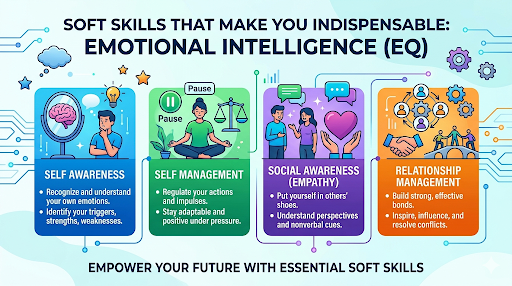
To truly master Emotional Intelligence, you need to understand its foundation. It is generally broken down into four distinct pillars. Let us explore each one in detail.
First up is Self Awareness. This is the bedrock of EQ. If you cannot understand your own emotions, you stand zero chance of understanding anyone else. Self awareness is about knowing your triggers, your strengths, and your weaknesses. It is the ability to take a step back in the heat of the moment and say to yourself, "I am feeling incredibly defensive right now because my idea was challenged." People with high self awareness do not let their emotions hijack their behavior. They observe their feelings without being controlled by them. They also have a very clear picture of how they are perceived by others, which is a rare and valuable trait.
The second pillar is Self Management. Once you are aware of your emotions, what do you do with them? Self management is your ability to regulate your reactions. It is the pause between feeling an emotion and acting on it. In the workplace, this looks like taking a deep breath instead of sending an angry reply to a frustrating email. It means staying adaptable when project requirements change at the last minute. It involves maintaining a positive outlook even when facing significant setbacks. Professionals who excel at self management are often seen as the anchors of their teams. They provide stability and calm in the midst of corporate chaos.
Next, we move outward to Social Awareness. If the first two pillars are about you, this one is about everyone else. The core component of social awareness is empathy. This is not about feeling sorry for someone; it is about putting yourself in their shoes and understanding their perspective. A socially aware person can walk into a meeting room and immediately read the vibe. They pick up on nonverbal cues, like crossed arms or avoiding eye contact, and they adjust their approach accordingly. They understand the power dynamics within the organization and know how to navigate them respectfully. Empathy builds trust, and trust is the currency of successful business.
Finally, we have Relationship Management. This is where it all comes together. Relationship management is your ability to use your self awareness, self management, and social awareness to build strong, effective bonds with others. It covers a wide range of interpersonal skills. It is your ability to inspire and influence your peers. It is your capacity to coach and mentor junior staff. It is your talent for resolving conflicts constructively rather than letting them fester. When you master relationship management, you become the glue that holds a team together. You turn casual acquaintances into loyal allies.
Why Employers Are Begging for High EQ
Now that we know what Emotional Intelligence is, let us talk about why it makes you so invaluable. The modern workplace is inherently stressful. It is fast paced, demanding, and constantly shifting. In this environment, technical skills are just the baseline requirement to get through the door. It is your EQ that dictates how high you will climb.
Think about the nature of modern work. Very few of us work in total isolation. We collaborate on projects, we brainstorm in meetings, we negotiate with vendors, and we serve clients. Every single one of these activities is fundamentally a human interaction. When a team is composed of individuals with high EQ, magic happens. Communication flows freely. People feel psychologically safe to share unconventional ideas without fear of being mocked. Mistakes are treated as learning opportunities rather than occasions for blame.
Furthermore, high EQ individuals are the ultimate problem solvers. Because they are not blinded by their own ego or defensive reactions, they can look at a crisis objectively. They can bring conflicting parties to the table, validate both sides, and find a compromise that keeps the project moving forward. Bosses love this. A managers biggest headache is usually not the work itself, but the interpersonal drama that prevents the work from getting done. If you are the person who resolves the drama instead of creating it, your boss will never want to let you go.
Additionally, as you move up the corporate ladder, EQ becomes exponentially more important. Leadership is not about doing the work; it is about inspiring others to do the work. You cannot lead effectively if you cannot connect with your team on an emotional level. You need to know when to push them harder and when to give them a break. You need to celebrate their victories and support them through their failures. Great leaders are almost always individuals with profound Emotional Intelligence.
Actionable Strategies to Skyrocket Your Emotional Intelligence
The best part about Emotional Intelligence is that, unlike IQ which is relatively fixed, EQ is completely malleable. It is a muscle that you can build with consistent practice. If you want to make yourself indispensable, here are some actionable ways to boost your EQ starting today.
Practice Active Listening: This is perhaps the most critical skill to develop. Most people do not listen to understand; they listen to reply. The next time you are in a conversation, focus entirely on the other person. Put your phone away. Do not interrupt them. Notice their body language and the tone of their voice. When they finish speaking, paraphrase what they said to ensure you understood them correctly. This simple act shows immense respect and builds instant rapport.
Embrace the Power of the Pause: When you feel yourself getting angry, frustrated, or defensive, do not react immediately. Force yourself to pause for just five seconds. Take a deep breath. This tiny window of time is enough to engage the logical part of your brain and prevent you from saying something you will regret.
Seek Constructive Feedback: You cannot improve your self awareness in a vacuum. You need external perspectives. Ask your trusted colleagues or your manager for honest feedback on how you handle stress, how you communicate, and how you affect the team dynamic. Listen to their answers without getting defensive. Thank them for their honesty and look for patterns in what they tell you.
Start a Reflection Journal: At the end of each day, spend five minutes writing down your emotional highs and lows. What triggered you today? How did you respond? What could you have done better? This daily habit forces you to confront your emotional patterns and gives you clear targets for improvement.
Cultivate Curiosity About Others: Make a genuine effort to learn about the people you work with. Ask them about their weekends, their hobbies, and their career aspirations. When you show authentic interest in your colleagues as human beings, you build a foundation of mutual trust and empathy.
Learn to Apologize Sincerely: Everyone makes mistakes. Having high EQ does not mean you are perfect. It means that when you mess up, you own it. A sincere apology involves acknowledging what you did wrong, validating the other persons feelings, and explaining how you will fix it. A proper apology can actually make a relationship stronger than it was before the conflict.
The Ripple Effect of High EQ
When you commit to developing your Emotional Intelligence, you will notice a ripple effect that touches every area of your life. Yes, it will make you indispensable at work. You will likely see better performance reviews, faster promotions, and stronger professional networks. But the benefits do not stop at the office door.
High EQ will improve your personal relationships. You will become a better partner, a better friend, and a better family member. You will find that you experience less stress and anxiety because you are no longer at the mercy of every passing emotion. You will navigate the inevitable challenges of life with a sense of calm resilience. You become a person that others are naturally drawn to because you make them feel seen, heard, and valued.
Employers are waking up to the incredible value of human centric skills. The future of work belongs to those who can master the intersection of technology and humanity. While you should absolutely continue to develop your technical expertise, do not neglect the softer side of success. Your ability to connect with others is your ultimate competitive advantage.
Conclusion
As we look toward the future, the landscape of employment will continue to shift in unpredictable ways. New software will be invented, entire industries will be disrupted, and job descriptions will evolve. However, the fundamental human need for connection, understanding, and empathy will never become obsolete. Emotional Intelligence is the golden thread that weaves together all your other skills, making them applicable and impactful in the real world. By dedicating time and effort to improving your self awareness, managing your reactions, cultivating empathy, and building strong relationships, you are doing more than just advancing your career. You are transforming yourself into an indispensable asset and a true leader. Start practicing these principles today, and watch as doors you never even knew existed begin to open for you.
Need help making the right career decision?
Explore KickStartX career counselling and education guidance services for personalised support, scientific assessments, and structured career planning.
Explore related KickStartX services
Continue from this topic to the most relevant counseling, admission, abroad studies, skills, and career pathway pages.