The Ultimate Guide on How to Learn Python From Scratch: A Fun Step by Step Journey
Welcome to the amazing and endlessly fascinating world of coding! If you are searching for the absolute best way to learn Python for beginners, you have landed in the perfect place. Learning a new programming language might initially seem like trying to read ancient alien text, but I promise you, it is much easier than you might think. Python is the ultimate language to start your tech journey. It is incredibly popular, highly readable, and packed with endless creative possibilities. Whether you want to build dynamic websites, dive deep into the futuristic realm of artificial intelligence, or just automate those boring daily tasks, Python is your ultimate best friend.
The Ultimate Guide on How to Learn Python From Scratch: A Fun Step by Step Journey
Welcome to the amazing and endlessly fascinating world of coding! If you are searching for the absolute best way to learn Python for beginners, you have landed in the perfect place. Learning a new programming language might initially seem like trying to read ancient alien text, but I promise you, it is much easier than you might think. Python is the ultimate language to start your tech journey. It is incredibly popular, highly readable, and packed with endless creative possibilities. Whether you want to build dynamic websites, dive deep into the futuristic realm of artificial intelligence, or just automate those boring daily tasks, Python is your ultimate best friend.
In this comprehensive guide, we will explore exactly how to learn Python from scratch. We will cover all the best strategies, top resources, and clever tricks to make your educational journey smooth, highly enjoyable, and totally stress free. Grab your favorite warm beverage, get extremely comfortable in your chair, and let us dive right into the pure magic of computer programming!
Why Choose Python As Your First Programming Language?
Before we get into the nuts and bolts of coding, let us answer a massive and very important question. Out of all the programming languages out there in the digital universe, why is everyone so utterly obsessed with this particular one?
It is incredibly beginner friendly. The syntax reads almost exactly like regular English. You do not have to memorize complicated symbols or weird brackets just to print a simple text message on your computer screen.
The community is absolutely massive and incredibly supportive. Whether you are seeking the best Python courses in London, studying remotely in the tech hubs of Bangalore India, or looking for local coding bootcamps in New York City, the global Python community is always ready to help you. No matter your geographic location, you can easily find a local tech meetup or a virtual study group to support your lofty career goals.
It pays exceptionally well. Skilled Python developers are in incredibly high demand across the globe. From data science roles to backend web development positions, mastering this specific language opens heavy doors to highly lucrative and stable career paths.
It is remarkably versatile. You can choose to build a simple desktop calculator today and smoothly transition to programming a complex machine learning algorithm tomorrow. The sky truly is the limit when you understand the core fundamentals.
Setting Up Your Digital Environment
Now that you are super excited and ready to begin, let us talk about the initial software setup. Many absolute beginners get stuck right here, but we are going to make it super easy and highly intuitive.
Download the Software: Head directly over to the official Python website and download the latest version specifically tailored for your operating system. It is completely free and completely open source.
Choose a Code Editor: You desperately need a special place to write your awesome code. Think of this tool as your highly advanced digital notebook. Visual Studio Code and PyCharm are absolutely fantastic choices for anyone just starting out. They automatically highlight your written code in pretty colors and catch your silly spelling mistakes before you even try to run the main program.
Say Hello to the World: Your very first coding program will be wonderfully simple. You will type a short command to print the exact words "Hello World" directly onto your screen. When you see those magical words successfully appear, give yourself a massive pat on the back. You are officially a real programmer!
The Core Building Blocks of Programming
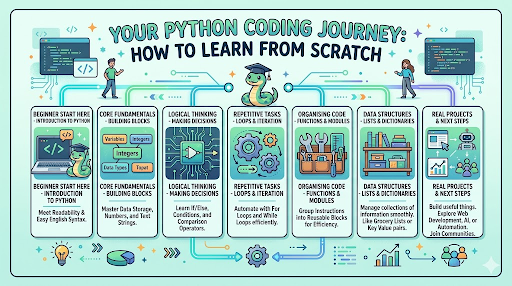
To truly master how to learn Python from scratch, you need to deeply understand the fundamental concepts. Treat these specific concepts exactly like the solid concrete foundation of a massive house. If your foundation is strong, you can easily build a towering skyscraper on top of it. Let us break down these essential core basics right now.
Variables: Think of variables as clearly labeled cardboard boxes where you securely store important information. You can easily have a box labeled "age" and safely put the number twenty five inside it.
Data Types: The computer needs to specifically know exactly what kind of data it is currently dealing with. Is it regular text? Is it a solid whole number? Is it a complex decimal? Understanding basic strings, integers, and floats is absolutely crucial to your future success.
Lists and Dictionaries: Sometimes you quickly need to store a large group of items together in one place. Lists are exactly like your weekly grocery shopping lists. Dictionaries act just like real life dictionaries, they securely hold a word and its specific definition, or in proper coding terms, a key and a corresponding value.
Conditionals: This is the exact moment where your code gets genuinely smart. You use "if" and "else" statements to force the computer to make logical decisions. For a simple example, if the weather is raining outside, bring an umbrella, else, wear your favorite sunglasses.
Loops: Professional programmers absolutely hate doing boring repetitive tasks. Loops safely allow you to tell the computer to do something a thousand times without you having to manually write the exact same line of code a thousand times. "For" loops and "while" loops will quickly become your absolute favorite daily tools.
Leveling Up Your Skills to Intermediate
Once you have successfully nailed the absolute basics, it is time to eagerly move onto slightly more advanced but incredibly fun software topics. This is the exact phase where you completely transition from a total novice beginner to a highly capable intermediate coder.
Functions: Imagine you have a deeply treasured family recipe for baking chocolate chip cookies. Instead of completely rewriting the long recipe every single time you want to bake a fresh batch, you just write it down once and clearly name it "bake cookies". Functions let you easily group blocks of code together and use them over and over again anywhere in your project.
Object Oriented Programming: This phrase sounds super intimidating to new people, but it is genuinely just a clever way to neatly organize your code by closely modeling real world objects. If you are actively building a racing video game, you might purposely create a digital object for a "Car" that has a specific color, a maximum speed, and a recognized brand name.
Modules and Libraries: You absolutely do not have to constantly reinvent the wheel. Python currently has a massive public collection of pre written code that you can just freely borrow and plug directly into your own personal projects. Do you want to do highly complex math equations? Simply import the math module. Do you want to successfully build a powerful web scraper? Just grab the famous Beautiful Soup library and start extracting data.
Project Based Learning Strategies
Here is a massive industry secret just for you. You absolutely cannot learn to confidently code just by passively watching videos or simply reading thick textbooks. You actually have to actively build real things! Project based learning is the ultimate proven strategy for fully mastering Python. Let us closely look at some absolutely fantastic beginner projects you can easily start working on right now today.
A Number Guessing Game: Carefully build a fun program where the computer secretly picks a random number and you have to logically guess what it is. The computer will actively tell you if your guess is way too high or way too low until you finally win.
A Daily Task Application: Creatively build a highly useful program where you can quickly add daily chores, easily mark them as totally complete, and permanently delete them. This specific project will teach you exactly how to cleanly manage user data effectively.
A Digital Calculator: Successfully write code that can cleanly add, safely subtract, quickly multiply, and perfectly divide large numbers based entirely on exactly what the user wants to accomplish.
A Global Weather App: Smartly use a free weather application programming interface to quickly fetch the current precise temperature for absolutely any major city in the entire world. This is an incredibly great way to learn exactly how your written code can successfully interact with the broader internet.
The Best Top Resources to Learn Python
You might be eagerly wondering where exactly you should go to properly learn all this amazing stuff. Luckily for you, the modern internet is completely packed to the brim with genuinely amazing educational resources.
Interactive Learning Platforms: Highly popular websites like Codecademy and freeCodeCamp are absolutely brilliant for new students because you get to write code directly inside your own web browser. There is absolutely no messy or confusing software setup required to get started.
Video Tutorials: The YouTube platform is a complete educational goldmine. You can easily find highly comprehensive Python programming basics courses that are over ten hours long and are completely free to watch. Just quickly search for a complete Python tutorial for absolute beginners and enjoy the show.
Educational Books: If you greatly prefer reading physical text, "Automate the Boring Stuff with Python" is a highly legendary book in the coding community. It heavily focuses on highly practical daily applications rather than boring theoretical concepts.
Local and Global Communities: Eagerly join active online forums like Reddit or Stack Overflow. If you are highly interested in geographic networking, quickly search for local Python meetups safely located in your specific home city or surrounding region. Engaging directly with a local tech community massively boosts your professional networking potential and easily helps you find dedicated study buddies right in your very own area.
Answer Engine Optimization Frequently Asked Questions
When curious people search the internet for basic information about computer coding, they often ask very specific and highly targeted questions. Modern search engines absolutely love providing clear direct answers to the public. Let us efficiently tackle some of the most incredibly common questions to fully ensure our ultimate guide provides maximum educational value.
What is Python primarily used for today?
Python is a highly versatile general purpose programming language widely used for a massive variety of digital tasks. It is heavily utilized in complex web development, deep data analysis, futuristic artificial intelligence, advanced machine learning, boring automation scripting, and even interactive video game development. Because of its massive global library ecosystem, it can honestly do almost anything you can imagine.
How long does it usually take to learn Python from scratch?
If you consistently study with deep focus for about one to two hours every single day, you can easily grasp the absolute core basics in roughly six to eight weeks. However, to actually become highly proficient enough to successfully land a high paying junior developer job, it usually takes most people around six to nine months of highly dedicated daily practice and intense project building.
Is Python actually easy to learn for someone with no experience?
Yes, especially when directly compared to many other older programming languages like C or Java, Python is globally considered very easy to learn. Its written syntax is incredibly clean, highly readable, and wonderfully intuitive for normal human beings. It completely removes a lot of the highly complex background memory management so you can fully focus your energy entirely on solving fun logical problems.
What is the absolute best way to practice writing Python?
The absolute best proven way to practice is by actively building fun real world projects. Always start extremely small with simple calculators or basic text based adventure games, and then very slowly increase the overall technical complexity of your software. Carefully reading code safely written by highly experienced professional developers on popular platforms like GitHub is also a truly fantastic way to dramatically improve your own personal coding skills.
Do I need advanced math skills to successfully learn Python?
No, you absolutely do not need highly advanced mathematical skills to fully learn the core basics of Python. Knowing basic addition, simple subtraction, regular multiplication, and standard division are usually more than enough for completing most beginner level coding projects. However, if you eventually plan to dive deeply into advanced data science or complex machine learning later on in your career, having a highly solid understanding of advanced statistics and basic calculus will be incredibly helpful to your success.
Avoiding Extremely Common Beginner Pitfalls
As you eagerly embark on this incredibly exciting educational journey, you will inevitably run into some frustrating roadblocks along the way. Every single professional programmer does. Here are some extremely common mistakes you must actively avoid.
Getting Stuck in Tutorial Hell: This highly frustrating phenomenon unfortunately happens when you continuously watch endless tutorial videos without ever actually writing your own completely original code. To successfully escape tutorial hell forever, you absolutely must close the video player and bravely try building something completely from your own wildly creative imagination.
Giving Up Way Too Early: You will definitely encounter annoying software errors. Your computer screen will likely turn bright red with scary looking error messages. Do not panic at all! Errors are genuinely just the computer completely failing to understand you and asking for simple clarification. Read the red message very carefully, exactly copy it directly into a major search engine, and you will almost certainly find an easy solution written by someone else.
Forgetting to Comment Your Code: When you cleverly write highly complex logic, always add a little helpful note written in plain simple English explicitly explaining exactly what the complicated code is supposed to do. If you happily come back to edit the exact same project three full months later, those tiny helpful comments will absolutely save your sanity.
Building Daily Habits for Massive Success
To truly master this wonderful language, you deeply need to build highly solid daily coding habits. Extreme consistency is the absolute secret sauce to achieving true greatness.
Practice Coding Every Single Day: Even if you only have a spare fifteen minutes before bed. Writing fresh code daily perfectly keeps the specific syntax fresh in your active memory. It is exactly like trying to learn a beautifully spoken language like Spanish or French. If you completely fail to practice speaking daily, you will very quickly forget the vocabulary.
Actively Read Other Peoples Code: Eagerly go explore fully open source software repositories and closely look at exactly how highly paid professionals expertly structure their massive projects. You will quickly learn clever secret tricks and industry best practices that standard beginner tutorials almost rarely ever cover.
Teach Others What You Currently Know: The absolute greatest way to completely solidify your own personal knowledge is to confidently explain it to someone else. Cheerfully write your own detailed blog posts, easily create a highly informative short tutorial video, or kindly help out another struggling beginner in an active online forum.
The Exciting Future of Python and Your Bright Career
We absolutely must take a moment to talk about the truly incredible professional future that eagerly awaits you once you completely master this awesome language. The global tech industry is currently evolving at highly terrifying lightning speed, and Python sits proudly at the very center of this massive digital revolution. With the incredibly massive current boom in generative artificial intelligence and global big data analytics, highly profitable companies are desperately searching every single day for truly talented developers who deeply understand exactly how to expertly manipulate complex algorithms and massive data structures.
By actively choosing to boldly learn Python from scratch starting today, you are safely securing and heavily future proofing your entire professional career. Whether you deeply desire to work entirely remotely from a beautifully sunny tropical beach, eagerly join a highly bustling energetic startup company located in a major metropolitan tech hub, or even bravely build your very own highly profitable software business from your cozy bedroom, fully mastering this language is your literal golden ticket to ultimate freedom. And always remember, the educational learning process never truly completely stops. Modern technology heavily updates itself constantly, which simply means there will always be a tremendously fun new software library or exciting digital framework for you to happily explore tomorrow.
A Final Concluding Thought on Your New Journey
Learning exactly how to successfully learn Python from scratch is completely and utterly one of the absolutely most highly rewarding professional decisions you will ever make in your entire life. It is a wildly exciting educational journey deeply filled with highly logical mind puzzles, extremely creative problem solving sessions, and incredibly exciting triumphant moments of pure joy. We have deeply covered the absolute best proven ways to safely start, directly from cleanly setting up your personal digital workspace to fully mastering crucial variables, complex loops, and highly reusable functions.
We happily explored incredibly fantastic beginner software projects and clearly highlighted the absolute very best educational resources currently available on the internet to safely guide you along the way. Always remember to stay incredibly patient with yourself during the hard days. Rome was absolutely not magically built in a single day, and neither is a highly skilled professional software programmer. Keep practicing your skills daily, keep happily building tremendously fun digital projects, and absolutely do not ever be afraid to make highly silly mistakes. The entire massive global Python community is excitedly cheering you on right now. So quickly open your favorite laptop computer, bravely write that very first magical line of fresh code, and happily welcome yourself to your wildly brilliant new life as a successful software developer. Happy coding out there!
Need help making the right career decision?
Explore KickStartX career counselling and education guidance services for personalised support, scientific assessments, and structured career planning.
Explore related KickStartX services
Continue from this topic to the most relevant counseling, admission, abroad studies, skills, and career pathway pages.