The Future of Creative Arts in the Digital Age Where Pixels Meet Passion
Have you ever stopped to think about what Leonardo da Vinci would do if he had an iPad Pro? Seriously, picture it. Instead of mixing egg yolks and pigments for hours on end, the ultimate Renaissance man might be swiping across a glowing screen with an Apple Pencil. He would probably be fascinated by the undo button alone! The intersection of technology and creativity is not exactly a new concept. Ever since humans first picked up a burnt stick to draw on a cave wall, we have been using the tools available to us to express our inner worlds. But today, the pace of technological change is making our collective heads spin. We are standing at the edge of a massive shift in how art is made, shared, and valued. Welcome to the digital age of the creative arts. It is a wildly exciting, slightly chaotic, and utterly fascinating time to be a creator or simply a fan of beautiful things. People often worry that computers and algorithms will somehow drain the soul out of human expression. They fear a dystopian future where robots write all our songs and paint all our masterpieces. But let us take a deep breath. The future of creative arts is not about machines replacing human imagination. It is about machines amplifying human imagination. We are talking about new canvases, new colors, and entirely new ways to connect with audiences. So grab your favorite digital stylus, settle in, and let us explore exactly what the future holds for the creative arts.
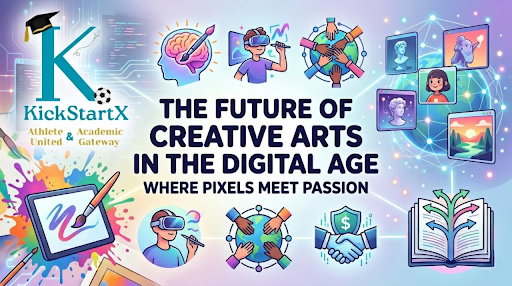
The Future of Creative Arts in the Digital Age Where Pixels Meet Passion
Have you ever stopped to think about what Leonardo da Vinci would do if he had an iPad Pro? Seriously, picture it. Instead of mixing egg yolks and pigments for hours on end, the ultimate Renaissance man might be swiping across a glowing screen with an Apple Pencil. He would probably be fascinated by the undo button alone! The intersection of technology and creativity is not exactly a new concept. Ever since humans first picked up a burnt stick to draw on a cave wall, we have been using the tools available to us to express our inner worlds. But today, the pace of technological change is making our collective heads spin. We are standing at the edge of a massive shift in how art is made, shared, and valued.
Welcome to the digital age of the creative arts. It is a wildly exciting, slightly chaotic, and utterly fascinating time to be a creator or simply a fan of beautiful things. People often worry that computers and algorithms will somehow drain the soul out of human expression. They fear a dystopian future where robots write all our songs and paint all our masterpieces. But let us take a deep breath. The future of creative arts is not about machines replacing human imagination. It is about machines amplifying human imagination. We are talking about new canvases, new colors, and entirely new ways to connect with audiences. So grab your favorite digital stylus, settle in, and let us explore exactly what the future holds for the creative arts.
The Artificial Intelligence Elephant in the Gallery
Okay, let us address the most talked about topic right away. Artificial intelligence. You have probably seen the headlines or scrolled past incredibly realistic images on social media that were entirely generated by a computer. Programs that can instantly turn a simple text prompt into a stunning landscape or a quirky portrait are changing the game. It is easy to look at these powerful tools and feel a little intimidated. If a computer can paint a masterpiece in ten seconds, what happens to the traditional painter?
The reality is far more nuanced and much more exciting. Artificial intelligence is not here to steal the brush from the artist. It is here to act as an incredibly fast, endlessly imaginative assistant. Think of it as a creative brainstorming partner that never gets tired.
Here are a few ways artificial intelligence is reshaping the creative process:
Rapid Prototyping: Concept artists working in film or video games can use artificial intelligence to generate dozens of mood boards and visual concepts in a single afternoon. This allows them to explore wild ideas quickly before committing to the final manual design.
Overcoming the Blank Canvas: Every writer, painter, and musician knows the absolute terror of starting from scratch. A quick prompt to a smart algorithm can provide a sudden spark of inspiration, a rough outline, or an unexpected color palette that gets the creative juices flowing again.
Enhancing Human Skill: Musicians are using artificial intelligence to master their tracks or generate complex background beats. Filmmakers use it to clean up audio or generate background scenery. The technology handles the tedious parts so the creator can focus entirely on the emotion and the storytelling.
The human element, the lived experience, the heartbreak, the joy, the unique perspective, is something no algorithm can ever replicate. A machine can paint a beautiful starry night, but it takes a human soul to pour agonizing loneliness and brilliant hope into the canvas the way Vincent van Gogh did. The art of the future will be a beautiful duet between human emotion and machine capability.
Immersive Worlds and Virtual Reality
Let us move past the flat screen. For centuries, visual art has been confined to a physical boundary like a picture frame, a movie screen, or a theatrical stage. The future is about breaking down those traditional walls and stepping entirely inside the imagination of the artist. Virtual reality and augmented reality are turning passive observers into active participants.
Imagine putting on a headset and walking right through a painting. You are not just looking at a forest scene. You are hearing the virtual leaves crunch beneath your feet, seeing the brushstrokes suspended in three dimensional space around you, and perhaps even interacting with the characters. Artists are no longer just painting pictures. They are building entire universes.
This monumental shift changes the very definition of what it means to experience art.
Sculpting in Thin Air: Digital sculptors are currently using virtual reality tools to mold and shape digital clay with their bare hands in a virtual space. They can walk around their creations, scale them to the size of a skyscraper, or shrink them down to the size of a tiny thimble.
Augmented Cityscapes: Street art is getting a massive digital upgrade. Imagine pointing your phone at a blank brick wall in your city and seeing a vibrant, animated mural burst into life through your screen. Augmented reality layers digital magic directly over the physical world.
Immersive Theater and Music: Musicians are hosting digital concerts in virtual worlds where millions of fans can gather as custom avatars to watch larger than life performances. The normal laws of physics do not apply here, meaning stage sets can morph, float, and explode in dazzling colors that would be impossible in a real physical arena.
This technology makes art a full body experience. It connects the viewer and the creator on a profoundly intimate level. You are not just seeing what the artist made. You are experiencing the world exactly as they envisioned it.
The Great Democratization of Creativity
Historically, the art world has been guarded by extremely heavy gates. If you wanted to be a successful musician, you needed a wealthy record label to fund your expensive studio time. If you wanted to be a published author, you needed a massive publishing house. If you wanted to show your paintings, you had to win the favor of elite gallery owners.
The digital age has brought a glorious sledgehammer to those restrictive gates. Today, anyone with a smartphone and a basic internet connection has instant access to a global audience. The barrier to entry has never been lower, and that is a massive victory for human expression.
Consider the amazing tools available to the modern amateur:
High Quality Production at Home: A teenager in their bedroom can produce a chart topping song using affordable software on a standard laptop. The professional recording studio is now completely digital and accessible.
Free Learning Resources: You do not need expensive art school tuition to learn how to draw, animate, or code. Video platforms are overflowing with masterful tutorials created by industry professionals who are eager to share their extensive knowledge for free.
Instant Global Distribution: Social media platforms and various blogging sites allow creators to bypass traditional media gatekeepers entirely. If your work resonates with people, it can go viral overnight, building a highly dedicated fanbase without spending a single penny on a marketing budget.
This means we are going to see a wider diversity of voices and stories than ever before in human history. Creativity is no longer limited to those who can afford expensive materials or elite connections. The future of art belongs to everyone. It is messy, it is loud, and it is beautifully chaotic because millions of fresh new voices are suddenly joining the global conversation.
The New Economics of Digital Art
Of course, we cannot talk about the future of creative arts without talking about how artists actually make a living. For a very long time, digital art had a major structural problem. It was infinitely copyable. If you painted a physical canvas, there was only one unique original. But if you created a brilliant digital illustration, anyone could simply right click and save it. How do you assign value to something that can be duplicated a million times for absolutely free?
Enter blockchain technology and the modern concept of digital ownership. Now, before you roll your eyes at the mention of confusing crypto trends, let us look at the fundamental underlying principle. The ability to mathematically verify the authenticity and true ownership of a digital asset is completely revolutionary for digital creators.
This technological shift is providing incredible benefits to the creative community:
Direct Patronage: Artists can finally sell their digital work directly to dedicated collectors without needing a middleman gallery taking a massive, unfair cut of the total profits.
Royalties on Resales: Unlike the traditional art market where an artist sells a painting once and sees zero profit if it later sells for millions at an auction, smart contracts can ensure that digital artists automatically receive a percentage of every single future resale of their work. This is a massive game changer for long term financial stability.
Community Funding: Independent creators are launching massive projects by selling digital tokens or digital perks directly to their biggest fans, successfully funding independent movies, video games, and comic books directly through their grassroots community support.
The technology is definitely still maturing, and it certainly has its wild west moments, but the core idea is here to stay. Digital artists finally have a viable path to protect their hard work and get paid fairly for their labor. When artists can easily pay their rent, they can make more art. It is a wonderful win for everyone involved.
The Evolution of Storytelling
At its core, art is fundamentally about telling stories. Whether it is a striking photograph that captures a beautiful fleeting moment, a grand symphony that expresses profound human grief, or a lengthy novel that builds an entirely new world, we use art to communicate our deeply shared human experience. The modern digital age is fundamentally changing both how those stories are told and how they are ultimately received by an eager audience.
We are rapidly moving away from traditional linear storytelling toward incredibly interactive narratives. Video games have been pioneering this exciting space for several decades, proving conclusively that giving the audience true agency can create incredibly powerful emotional experiences. Now, many other art forms are rapidly catching up to this trend.
Think about interactive documentaries where the viewer actually chooses which personal perspective to follow. Consider brilliant digital poetry that subtly changes its wording based on the current time of day or the actual local weather outside the reader window. Imagine live theatrical performances streamed globally where the home audience votes collectively on the important actions of the main characters.
The traditional boundary between the wise storyteller and the passive audience is rapidly blurring. We are no longer just sitting back quietly and being told a neat story. We are boldly stepping right inside the vibrant narrative and actively helping to shape its final outcome. This makes art much more personal, far more engaging, and incredibly dynamic. The story beautifully adapts to the unique observer.
Conclusion
The glorious future of creative arts in the digital age is a dazzling, endlessly expansive frontier. Yes, there are certainly complex challenges to navigate along the way. We have to figure out exactly how to handle tricky copyright issues, fiercely protect artists and their livelihoods, and ensure that cold algorithms do not drown out genuine, warm human voices. But the sheer potential for artistic innovation is absolutely staggering to think about.
We are unbelievably lucky to be living in an era where the only real limit to what we can create is the extent of our own boundless imagination. Modern technology is providing us with a truly magical box of infinite creative tools. We can paint with pure light, sculpt freely in virtual space, collaborate easily across vast oceans, and share our deepest, most vulnerable emotions with a massive global audience in the simple blink of an eye.
Ultimately, the digital age does not ever replace the beating heart of the artist. It simply gives that brave heart a much bigger megaphone and a vastly broader canvas to play with. The true essence of art, the deep human desire to connect, to clearly understand, and to beautifully express the complex beauty and deep tragedy of the human condition, remains exactly the same as it was in the caves. The tools will keep evolving and changing, but the raw passion behind them will endure forever. So, whatever your chosen creative outlet might be, fully embrace the incredible digital tools at your disposal today. The whole world is waiting patiently to see what you will excitedly make next.
Need help making the right career decision?
Explore KickStartX career counselling and education guidance services for personalised support, scientific assessments, and structured career planning.
Explore related KickStartX services
Continue from this topic to the most relevant counseling, admission, abroad studies, skills, and career pathway pages.