The Great Student Tightrope: How to Crush Your Grades Without Becoming a Hermit
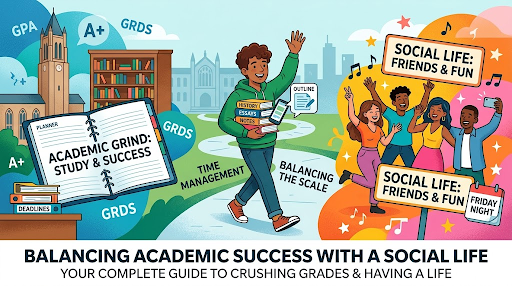
Welcome to the ultimate survival guide for the modern student. If you are reading this, you are likely caught between two very loud voices in your head. One voice is screaming about a fifteen page research paper due on Monday morning. The other voice is reminding you that your friends are currently at that new taco spot downtown and you are missing out on some legendary core memories. This is the classic dilemma: Academic Success versus Social Life. For decades, the myth has been that you can only pick one. If you want the 4.0 GPA, you must live in the library, smell like old energy drinks, and forget what sunlight looks like. If you want the thriving social life, you have to accept that your transcript will look like a disaster movie. But here is the secret: The most successful people in the world are not the ones who choose one side. They are the ones who learn how to balance on the tightrope. Let’s dive into how you can get those A grades while still having a life that is worth posting about.
The Great Student Tightrope: How to Crush Your Grades Without Becoming a Hermit
Welcome to the ultimate survival guide for the modern student. If you are reading this, you are likely caught between two very loud voices in your head. One voice is screaming about a fifteen page research paper due on Monday morning. The other voice is reminding you that your friends are currently at that new taco spot downtown and you are missing out on some legendary core memories.
This is the classic dilemma: Academic Success versus Social Life. For decades, the myth has been that you can only pick one. If you want the 4.0 GPA, you must live in the library, smell like old energy drinks, and forget what sunlight looks like. If you want the thriving social life, you have to accept that your transcript will look like a disaster movie.
But here is the secret: The most successful people in the world are not the ones who choose one side. They are the ones who learn how to balance on the tightrope. Let’s dive into how you can get those A grades while still having a life that is worth posting about.
Why Balance is Actually a Superpower
Before we get into the "how," let’s talk about the "why." Why bother balancing at all? Why not just grind for four years and party later?
The truth is that your brain actually functions better when you are happy. Scientific studies consistently show that social interaction reduces stress and prevents burnout. When you are less stressed, your cognitive functions improve. You retain information faster. You write more clearly. By hanging out with friends, you are technically "charging your battery" so you can study more effectively later.
On the flip side, having a solid academic foundation gives you peace of mind. It is much easier to enjoy a Saturday night out when you know your assignments are already submitted. No one wants to be the person at the party staring at their phone, checking the grading portal with a look of pure terror.
Step One: The Art of the Realistic Schedule
Most students fail because they try to plan their lives like robots. You are not a robot. You are a human who gets tired, gets hungry, and occasionally gets distracted by cat videos.
To achieve balance, you need a calendar, but you need to use it differently. Instead of just marking down your classes and exams, you need to mark down your "Non-Negotiables."
Sleep: If you don't sleep, your brain is basically a wet noodle.
Social Blocks: Explicitly schedule time for fun. If you know Friday night is "Movie Night," you will work harder on Thursday to make it happen.
The Buffer Zone: Always leave an hour a day for "nothing." This is for when life happens—like a long line at the coffee shop or an impromptu chat with a neighbor.
When you treat your social life as a scheduled appointment, it stops feeling like a "distraction" and starts feeling like a part of your routine.
High Intensity Studying: The Secret to Free Time
The biggest time waster in the history of education is "Fake Studying." You know exactly what this is. It is when you sit in the library for six hours, but four of those hours are spent scrolling through social media, two hours are spent talking to people who walk by, and maybe thirty minutes are spent actually reading.
If you want a social life, you have to kill the Fake Study habit. Instead, adopt High Intensity Studying.
The Pomodoro Technique: Work for twenty five minutes with zero distractions. No phone. No music with lyrics. Then take a five minute break. After four rounds, take a longer break.
Active Recall: Stop re reading your notes. It is a waste of time. Instead, close the book and try to explain the concept to an imaginary audience. If you can explain it, you know it.
Eat the Frog: Do the hardest, most annoying task first thing in the morning. Once the "Frog" is eaten, the rest of the day feels like a breeze.
By increasing your focus, you can finish in two hours what usually takes you six. That is four extra hours of social time you just "earned" back.
Socializing with a Purpose
Who says academics and social lives have to be separate? Some of the best memories are made when you combine the two.
Study Groups: Find people in your major who are as motivated as you are. You can quiz each other, share notes, and then grab pizza afterward.
The Library Buddy: Even if you aren't in the same class, sitting at a table with a friend while you both work creates a sense of "shared struggle" that makes the work feel lighter.
Campus Clubs: Join a club that aligns with your interests. This is "productive socializing." You are building your resume and meeting people at the same time.
Setting Boundaries with Your Social Circle
This is the hard part. Sometimes, your friends will want to go out when you genuinely have to study. Learning to say "no" or "not right now" is a vital life skill.
True friends will understand when you say, "I really want to come, but I have to finish this project first. Can we meet up for breakfast tomorrow instead?"
If your social circle pressures you to neglect your responsibilities, it might be time to evaluate those friendships. You want to surround yourself with "Radiators" (people who encourage your growth) not "Drains" (people who pull you down).
The Importance of Environment
Where you work matters just as much as how you work. If you try to study in your bed, your brain thinks it is time to sleep. If you try to study at a party, your brain thinks it is time to dance.
Find your "Flow State" locations.
The Quiet Zone: For deep focus, like writing essays or solving complex math.
The Coffee Shop: For "light" work like answering emails or organizing your planner.
The Outdoor Bench: For reading or brainstorming.
By changing your environment, you signal to your brain what "mode" you are in. When you leave the "Study Zone," you leave the stress behind. This allows you to be 100% present when you are out with friends.
Managing the "Post-Weekend" Slump
We have all been there. You had an amazing weekend, but now it is Monday morning and you feel like you have been hit by a truck.
To prevent the Sunday Scaries, use the "Sunday Reset" method:
Spend thirty minutes on Sunday evening reviewing your week ahead.
Pack your bag and pick out your outfit.
Review your syllabus so there are no surprises on Monday.
This small habit allows you to transition from "Social Mode" back into "Academic Mode" without the emotional whiplash.
Health: The Foundation of Everything
You cannot balance a social life and school if you are constantly sick or exhausted.
Hydrate: Drink water like it is your job.
Move: Even a fifteen minute walk can clear your head and boost your mood.
Eat Real Food: Instant noodles are fine occasionally, but your brain needs actual nutrients to function.
Think of yourself like a high performance athlete. You are training for the "Academic Olympics." You need to fuel your body accordingly.
The Mental Game: Forgiving Yourself
There will be weeks where the balance is off. There will be weeks where you have three midterms and you don't see your friends at all. There will be other weeks where it is someone’s birthday or a holiday and you barely open a book.
That is okay.
Balance is not a daily requirement; it is a long term goal. If you have a "bad" week academically, don't beat yourself up. Just adjust and make it up the following week. If you feel lonely, prioritize a social outing. Perfection is the enemy of progress.
How Technology Can Help (And Hurt)
We live in a digital age. Use it to your advantage.
App Blockers: Use apps that lock your social media during study hours.
Shared Calendars: Use digital calendars to sync up with friends so you know exactly when everyone is free.
Voice Notes: If you are walking to meet a friend, use that time to listen to a recorded lecture or record your own thoughts for an essay.
However, be wary of the "Social Media Comparison Trap." Just because your classmates look like they are partying every night doesn't mean they actually are. Most people only post the highlights. Don't let someone else’s curated feed make you feel guilty about your own balance.
Strategies for Different Personalities
Are you an Introvert or an Extrovert? This changes how you should balance your life.
For the Extroverts:
You gain energy from people. Your risk is overcommitting socially and neglecting your desk time. Try to find "Study Partners" so you don't feel isolated while working.
For the Introverts:
You gain energy from being alone. Your risk is becoming a hermit and forgetting to socialize. Challenge yourself to one social event per week. Remember that "socializing" can just be grabbing coffee with one person; it doesn't have to be a loud party.
The Financial Side of Socializing
Let’s be real: Socializing can be expensive. Between dinners, drinks, and events, your bank account can take a hit. Financial stress is a major "Balance Killer."
Host Potlucks: Instead of going to an expensive restaurant, have everyone bring a dish to your place.
Free Campus Events: Most colleges have free movies, concerts, and guest speakers. Take advantage of them!
Student Discounts: Never pay full price. Use your student ID for everything from software to sandwiches.
When your finances are in order, you have one less thing to worry about, making it easier to focus on your studies.
Career Benefits of a Social Life
Believe it or not, your social life is actually "Professional Development."
When you are talking to people, joining clubs, and navigating social situations, you are building "Soft Skills." Employers today care just as much about communication, teamwork, and leadership as they do about your GPA.
The person who can talk to anyone and handle a room is often the person who gets the job offer over the person who has a perfect score but zero social skills. Consider every social interaction as practice for your future career.
Conclusion: Finding Your Unique Rhythm
At the end of the day, there is no "one size fits all" formula for balancing academic success with a social life. Your "perfect balance" will look different from your roommate’s or your best friend’s.
The key is intentionality.
Stop letting your life "happen" to you. Take control of your time. Be present in whatever you are doing. When you are studying, be the best student in the room. When you are out with your friends, be the life of the party.
You only get to be a student once. It is a unique time in your life where you are surrounded by thousands of people your age, all going through the same thing. Don't spend the whole time stressed out, and don't spend the whole time slacking off.
Find your rhythm. Stay organized. Stay healthy. And most importantly, enjoy the ride.
Summary Checklist for Success:
Audit your current time usage to find "time leaks."
Schedule your fun time just as strictly as your study time.
Use high intensity study methods to maximize efficiency.
Combine social and academic goals through study groups.
Learn the power of a polite "no" when you are overwhelmed.
Maintain your physical health to keep your energy high.
Forgive yourself when the balance tips one way or the other.
By following these steps, you will find that "The Tightrope" isn't actually that scary. In fact, the view from the top is pretty great. Now, go finish that assignment so you can go out tonight!
Need help making the right career decision?
Explore KickStartX career counselling and education guidance services for personalised support, scientific assessments, and structured career planning.
Explore related KickStartX services
Continue from this topic to the most relevant counseling, admission, abroad studies, skills, and career pathway pages.