CA vs CFA: Key Differences, Career Scope, Eligibility and Salary in India
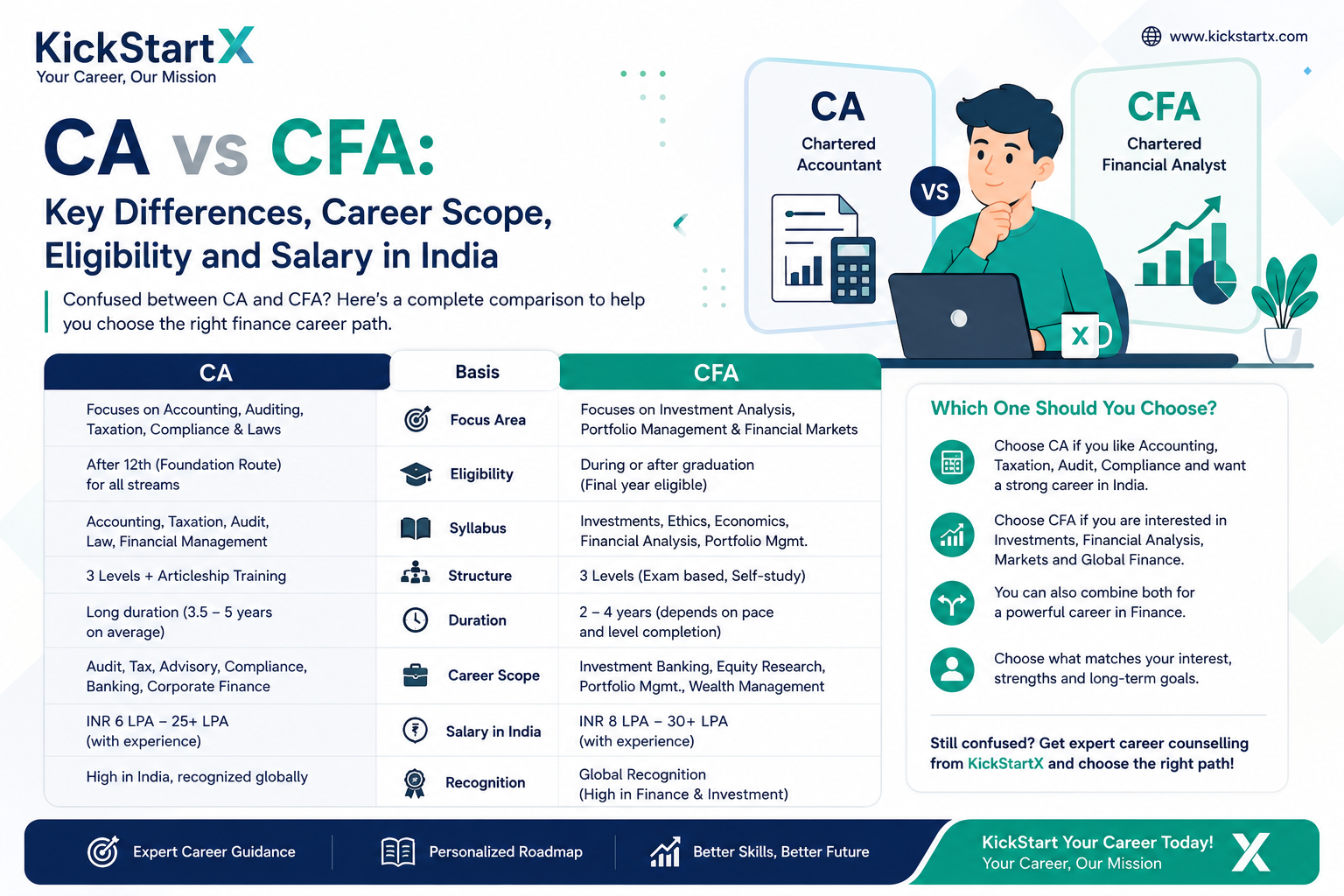
Confused between CA and CFA after 12th or graduation? This guide explains the key differences between Chartered Accountancy and Chartered Financial Analyst, including eligibility, syllabus, difficulty, career scope, salary expectations and which path may be better for students interested in accounting, taxation, finance, investment banking or global finance careers.
CA vs CFA: Key Differences, Career Scope, Eligibility and Salary in India
Finance is one of the most powerful career fields for students who enjoy numbers, business, analysis, strategy and decision-making. But when students start exploring professional finance courses, two options often create confusion: CA and CFA.
Many students search for questions like “CA vs CFA which is better”, “difference between CA and CFA”, “CA vs CFA salary in India” or “can I do CFA after CA”. Both qualifications are respected, but they are not the same. CA and CFA lead to different types of finance careers.
CA is more focused on accounting, taxation, audit, compliance and corporate finance. CFA is more focused on investment analysis, portfolio management, equity research, financial modelling and global finance.
The right choice depends on your interest, career goals, academic comfort and long-term plans.
What Is CA?
CA stands for Chartered Accountancy. It is one of the most respected professional qualifications in India for students who want to build a career in accounting, taxation, audit, finance and business advisory.
CA professionals usually work in areas such as:
Accounting
Taxation
Auditing
Financial reporting
Corporate laws
Compliance
Business advisory
Internal audit
Corporate finance
Consulting
CA is a strong career option for students who like structured finance, legal compliance, accounting systems and business regulations.
What Is CFA?
CFA stands for Chartered Financial Analyst. It is a globally recognised finance qualification focused on investment management and financial analysis.
CFA is suitable for students and professionals interested in:
Investment banking
Equity research
Portfolio management
Wealth management
Financial modelling
Risk analysis
Asset management
Capital markets
Global finance
Valuation
CFA is especially useful for students who are interested in financial markets, investment decisions and analytical finance roles.
CA vs CFA: Basic Difference
CA and CFA both belong to the finance field, but their focus is different.
CA focuses more on accounting, taxation, audit and compliance.
CFA focuses more on investment analysis, portfolio management and financial markets.
Simple comparison:
CA is better for accounting, audit, taxation and compliance roles
CFA is better for investment banking, equity research and portfolio management roles
CA is highly India-focused but also valuable abroad
CFA has strong global recognition in finance and investment sectors
CA involves articleship and practical training
CFA is exam-level based and more self-study oriented
Students should not choose only based on popularity. They should choose based on career fit.
Eligibility for CA
Students can start CA after 12th through the foundation route. Commerce students often choose CA, but students from other streams can also explore it if they are interested in finance and accounting.
CA generally requires:
12th completion for foundation route
Registration with the relevant professional body
Clearing multiple exam levels
Practical training or articleship
Strong understanding of accounting, taxation and law
Long-term preparation and discipline
CA is a long journey, so students should be mentally prepared for consistent study and practical training.
Eligibility for CFA
CFA is usually pursued by students during graduation, after graduation or by working professionals. It is more common among students interested in investment and global finance careers.
CFA generally requires:
Graduation or final-year graduation eligibility depending on rules
Strong interest in finance and investment
Analytical and quantitative ability
English comprehension
Self-discipline for exam preparation
Interest in global financial markets
Commerce, finance, economics, management and even engineering students can consider CFA if they are interested in investment analysis and finance.
CA vs CFA Syllabus
The syllabus difference is one of the biggest deciding factors.
CA syllabus usually includes:
Accounting
Cost accounting
Taxation
Auditing
Corporate laws
Financial management
Strategic financial management
Business regulations
Ethics and compliance
CFA syllabus usually includes:
Ethics and professional standards
Economics
Financial reporting and analysis
Quantitative methods
Equity investments
Fixed income
Derivatives
Alternative investments
Portfolio management
Corporate issuers
Students who enjoy accounting, taxation and law may find CA more suitable. Students who enjoy markets, investments and analysis may prefer CFA.
Which Is Tougher: CA or CFA?
Both CA and CFA are challenging, but the difficulty is different.
CA can feel difficult because:
The syllabus is vast
Exam levels are demanding
Passing percentage can be low
Articleship has to be managed with studies
Taxation, audit and law require strong conceptual clarity
The journey can take several years
CFA can feel difficult because:
Concepts are analytical
Finance theory can be deep
Quantitative topics require practice
Investment valuation needs strong understanding
Each level requires serious preparation
Self-study discipline is very important
CA is more comprehensive and operational. CFA is more specialised and analytical.
CA Career Scope in India
CA has strong career scope in India because every business needs accounting, taxation, audit and compliance support.
CA professionals can work in:
Audit firms
Tax consultancy firms
Corporate finance departments
Banks
MNCs
Startups
Government organisations
Financial advisory firms
Consulting companies
Internal audit departments
Common job roles after CA include:
Chartered Accountant
Tax consultant
Auditor
Finance manager
Internal auditor
Accounts manager
Risk consultant
Compliance manager
Corporate finance executive
Business advisor
CA is a good choice for students who want a stable and respected finance career in India.
CFA Career Scope in India
CFA is useful for students who want to build careers in investment and analytical finance.
CFA candidates and charterholders can explore roles in:
Investment banking
Equity research
Asset management
Portfolio management
Wealth management
Financial modelling
Risk management
Private equity
Fintech
Corporate strategy
Common job roles after CFA include:
Equity research analyst
Investment analyst
Portfolio analyst
Wealth manager
Financial analyst
Risk analyst
Investment banking analyst
Valuation analyst
Fund management associate
Corporate finance analyst
CFA can be a strong option for students who want exposure to global finance and investment roles.
CA vs CFA Salary in India
Salary depends on many factors such as skills, experience, city, company, industry, communication ability and practical exposure.
A CA may earn well in:
Audit
Taxation
Corporate finance
Consulting
Compliance
Financial reporting
Senior finance leadership roles
A CFA may earn well in:
Investment banking
Equity research
Portfolio management
Asset management
Wealth management
Financial modelling
Fintech and global finance roles
Neither CA nor CFA guarantees high salary automatically. Career growth depends on skill, performance, networking, internships, certifications, practical exposure and the industry you enter.
Students should not choose only based on salary. They should choose based on interest and career fit.
CA vs CFA: Which Is Better for Investment Banking?
For investment banking, CFA can be more directly relevant because it covers valuation, equity, fixed income, portfolio management and financial analysis.
However, CA students can also enter investment banking, especially if they build additional skills in:
Financial modelling
Valuation
Excel
Corporate finance
Mergers and acquisitions
Data analysis
Business strategy
A CA + CFA combination can be powerful for students interested in investment banking, corporate finance or consulting.
Can CA and CFA Be Done Together?
Yes, many students explore CFA along with or after CA. But students should be careful with workload.
CA already requires serious preparation. CFA also needs disciplined study. Doing both together can be useful only if the student has strong time management and clear career goals.
CA + CFA can be useful for careers in:
Investment banking
Corporate finance
Financial consulting
Mergers and acquisitions
Equity research
Valuation
Portfolio management
Fintech
Students should not combine both only for status. They should combine them if their career goal truly needs both.
CA May Be Better If
CA may be a better option if:
You enjoy accounting and taxation
You are interested in audit and compliance
You want a strong finance career in India
You like structured financial reporting
You are comfortable with law and regulations
You want to work with businesses and corporates
You are ready for articleship and long-term preparation
You want a recognised professional qualification in India
CA is suitable for students who like detailed financial systems and business compliance.
CFA May Be Better If
CFA may be a better option if:
You enjoy financial markets
You are interested in investment analysis
You like valuation and portfolio management
You want global finance exposure
You are comfortable with analytical concepts
You want to work in investment banking or equity research
You prefer self-paced professional preparation
You are interested in asset management or wealth management
CFA is suitable for students who like analysis, markets and investment decision-making.
CA vs CFA for Commerce Students
Commerce students often consider CA first because it connects directly with accounting, taxation and audit. But students who are more interested in markets and investment can explore CFA during or after graduation.
Commerce students should ask:
Do I like accounting or investment analysis more?
Am I interested in taxation and audit?
Do I want corporate finance or capital markets?
Am I ready for CA articleship?
Do I want global finance exposure?
Which career lifestyle suits me better?
The answer will help them choose the right path.
CA vs CFA for Science Students
Science students can also explore finance careers if they are genuinely interested in numbers, business and analysis.
Science students may consider CA if they want to move into accounting, taxation and finance after 12th.
Science or engineering students may consider CFA if they are interested in analytics, financial modelling, investment banking, fintech or quantitative finance.
A science background can be useful in analytical finance if the student builds finance knowledge properly.
Skills Needed for CA and CFA
Both CA and CFA need strong skills beyond exams.
Useful skills for CA:
Accounting knowledge
Tax understanding
Audit skills
Legal awareness
Attention to detail
Business communication
Excel skills
Compliance knowledge
Report writing
Useful skills for CFA:
Financial analysis
Valuation
Excel and financial modelling
Analytical thinking
Economics understanding
Market awareness
Research skills
Portfolio thinking
Data interpretation
Students who build practical skills along with qualification get better career opportunities.
Common Mistakes Students Make
Many students choose CA or CFA without understanding the difference.
Common mistakes include:
Choosing CA only because parents suggested it
Choosing CFA only because it sounds global
Comparing only salary and ignoring interest
Not understanding syllabus difference
Not checking career roles
Ignoring difficulty level
Not building practical skills
Not taking internships seriously
Thinking qualification alone guarantees success
Not taking career counselling before deciding
A finance career should be chosen with clarity, not pressure.
How KickStartX Helps Finance Students
KickStartX helps students compare career options based on interests, aptitude, academic background and long-term goals.
For students confused between CA and CFA, KickStartX can help with:
Career counselling after 12th Commerce
Finance career guidance
CA vs CFA comparison
Course selection
Skill development roadmap
Study abroad finance options
Career planning for commerce students
Resume and interview preparation
Data analytics and Excel roadmap
Long-term finance career planning
The goal is to help students choose the right finance path instead of following confusion or trends.
Final Advice
CA and CFA are both respected finance qualifications, but they are different. CA is better aligned with accounting, taxation, audit and compliance. CFA is better aligned with investment analysis, portfolio management, equity research and global finance.
The best option depends on your interest, strengths and career goals.
If you are confused between CA and CFA, do not decide only based on salary or popularity. Understand the syllabus, career roles, difficulty level and long-term scope.
KickStartX can help students and parents compare finance career options and build a clear roadmap for the right professional path.
Need help making the right career decision?
Explore KickStartX career counselling and education guidance services for personalised support, scientific assessments, and structured career planning.
Explore related KickStartX services
Continue from this topic to the most relevant counseling, admission, abroad studies, skills, and career pathway pages.