Thinking Like a Detective: Your Guide to Surviving the Age of Misinformation
Welcome to the twenty first century, friends! It is a magical time. We have all the knowledge of the world right here in our pocket, accessible in seconds. You want to learn how to change a tire? Here is a video. You want the history of the llama? A quick search, and you know everything. Want to see what a distant acquaintance had for breakfast? Well, that is on social media too. But this incredible gift comes with a serious, slightly terrifying downside. The internet is like a firehose of information, and it is firing twenty four hours a day. There is no filter, no off switch, and definitely no guarantee that what is hitting you is true. We are drowning in data, yet we are often starving for wisdom. In this environment, misinformation spreads like wildfire in a dry forest. It is everywhere: in your newsfeed, your group chats, and your inbox. Fake news, propaganda, deepfakes, twisted statistics, and "alternative facts"—it feels like we are living in a spy novel where everyone is lying to us. If we are not careful, we can end up believing things that are completely untrue, making poor decisions based on that belief, and even spreading that misinformation to others, making the problem worse. This is not just about being embarrassed when you share an Onion article thinking it is real. This can impact real life choices like how we treat our health, who we vote for, and how we view our neighbors. The good news is that we are not helpless. We have a powerful weapon in this war for truth, and it is not a piece of software or a new law. It is a mental skill that we can all develop and sharpen. It is called critical thinking. Think of critical thinking as your internal detector for garbage. It is the ability to analyze information, question its validity, and make a reasoned judgment about whether it is true, false, or somewhere in between. It is not about being a downer or a cynic who believes nothing. It is about being a detective, a skeptic, and an analyst rolled into one. In this age of misinformation, this skill is not just a "nice to have." It is absolutely essential for intellectual survival. So, how do we do it? How do we stop being passive consumers of content and start being active, critical thinkers? It starts with building your own toolkit for navigating the internet.
Thinking Like a Detective: Your Guide to Surviving the Age of Misinformation
Welcome to the twenty first century, friends! It is a magical time. We have all the knowledge of the world right here in our pocket, accessible in seconds. You want to learn how to change a tire? Here is a video. You want the history of the llama? A quick search, and you know everything. Want to see what a distant acquaintance had for breakfast? Well, that is on social media too.
But this incredible gift comes with a serious, slightly terrifying downside. The internet is like a firehose of information, and it is firing twenty four hours a day. There is no filter, no off switch, and definitely no guarantee that what is hitting you is true. We are drowning in data, yet we are often starving for wisdom. In this environment, misinformation spreads like wildfire in a dry forest. It is everywhere: in your newsfeed, your group chats, and your inbox.
Fake news, propaganda, deepfakes, twisted statistics, and "alternative facts"—it feels like we are living in a spy novel where everyone is lying to us. If we are not careful, we can end up believing things that are completely untrue, making poor decisions based on that belief, and even spreading that misinformation to others, making the problem worse. This is not just about being embarrassed when you share an Onion article thinking it is real. This can impact real life choices like how we treat our health, who we vote for, and how we view our neighbors.
The good news is that we are not helpless. We have a powerful weapon in this war for truth, and it is not a piece of software or a new law. It is a mental skill that we can all develop and sharpen. It is called critical thinking.
Think of critical thinking as your internal detector for garbage. It is the ability to analyze information, question its validity, and make a reasoned judgment about whether it is true, false, or somewhere in between. It is not about being a downer or a cynic who believes nothing. It is about being a detective, a skeptic, and an analyst rolled into one. In this age of misinformation, this skill is not just a "nice to have." It is absolutely essential for intellectual survival.
So, how do we do it? How do we stop being passive consumers of content and start being active, critical thinkers? It starts with building your own toolkit for navigating the internet.
The Psychology of Why We Are So Easily Fooled
Before we get to the toolkit, it helps to understand why we are so vulnerable to misinformation in the first place. This is not about calling anyone stupid. Smart people fall for fake news all the time. Our brains are actually wired in ways that make us susceptible to it.
The biggest culprit is something psychologists call confirmation bias. This is our natural tendency to search for, interpret, favor, and recall information in a way that confirms our preexisting beliefs. If you already believe that a certain kind of food is unhealthy, and you see an article with a sensational headline about how that food causes a dangerous disease, you are much more likely to believe it and share it. Why? Because it confirms what you already "know." You are less likely to click on the article, read it critically, or check the source, because your brain has already decided it must be true.
Another powerful factor is our emotional response. Information that makes us feel strong emotions, particularly anger, fear, or outrage, is far more likely to go viral. We are emotional creatures. When we see something that makes us mad or confirms our fears, we are tempted to share it immediately, often without even reading past the headline. The creators of misinformation understand this perfectly. They design their headlines to trigger your emotions, knowing that logic often takes a backseat to feelings.
The speed at which information travels today also plays a huge role. We are in a constant rush, scrolling quickly, absorbing headlines in a split second. The platforms themselves are designed for speed and sharing, not for slow, deliberate analysis. By the time someone fact checks a piece of fake news, it has often already been shared thousands or even millions of times. The correction never travels as fast as the lie.
The Critical Thinking Detective Kit: Tools for the Modern Age
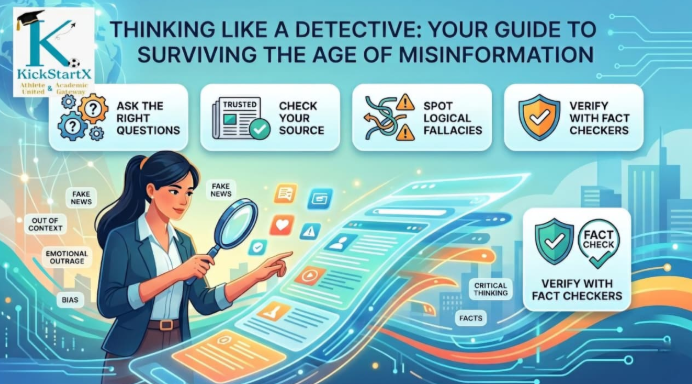
Now that we know what we are up against, let us build that toolkit. Imagine you are Sherlock Holmes, but instead of solving a murder mystery, you are solving the mystery of whether that shocking news article is real. Here are the tools you need in your detective kit:
Question Everything (Especially the Stuff You Agree With).
This is the first and most important rule. Adopt a stance of healthy skepticism. When you see a new piece of information, do not ask "Is this true?" Instead, ask "Why should I believe this is true?" This subtle shift forces the burden of proof onto the information itself. And be especially critical of information that perfectly aligns with your beliefs. That is when your confirmation bias is most dangerous.Become a Source Detective.
Who is creating this information? Is it a well known, respected news organization with a history of fact checking and corrections? Or is it a website you have never heard of, with a suspicious looking domain name? (Think "realnews4u.biz" instead of "bbc.com.") Check the "About Us" page. Look for a bias. Is this a satire site, a propaganda outlet, or a legitimate journalistic endeavor? Just because a site looks like a news site does not mean it is one. A lot of misinformation is hosted on "pink slime" sites that impersonate local news.Dig into the Claims (and the Authors).
Does the author have expertise in this subject? An opinion piece on quantum physics written by a celebrity is probably not as reliable as one written by a physics professor. Check if the article cites its sources. Are there links to original research, data, or reports? If the article just states shocking facts with no evidence, that is a massive red flag. Follow the links. Sometimes, an article will cite a study, but when you look at the study, it actually says the opposite of what the article claims.Look Beyond the Emotional Headline.
The whole purpose of a headline is to grab your attention. This is often done by sensationalizing the story or appealing to your emotions. "Clickbait" is a real problem. Headlines can be misleading or outright false, even when the article itself is more nuanced. Read the full article before you form an opinion or share it. Ask yourself: is the headline supported by the actual evidence in the article? If the title makes you furious, that is a big clue to proceed with caution.Check the Date (and the Context).
This is an unbelievably common tactic. Old news, sometimes from years ago, will resurface and be shared as if it just happened. This can make an issue seem current and urgent when it is not. A video of a protest from five years ago can be reposted and presented as a protest that is happening right now, completely changing its meaning. Always check when the information was first published.Spot the Logical Fallacies.
Misinformation often relies on flawed logic. These are common errors in reasoning that can make an argument sound convincing when it is actually garbage. Watch out for things like:
The Ad Hominem Attack: Attacking the person making the argument, rather than the argument itself.
The False Dichotomy: Presenting only two choices as if they are the only options, when there are actually many.
The Slippery Slope: Claiming that one minor action will inevitably lead to a chain of terrible events.
The Appeal to Popularity: Arguing that something must be true just because many people believe it.
The Straw Man: Misrepresenting an opponent's argument to make it easier to attack.
Consult the Expert Fact Checkers.
This is one of the best tools at your disposal. There are dedicated organizations whose entire job is to investigate viral claims and misinformation. Before you hit share, take ten seconds to check their sites. If they have already debunked a story, they will have a detailed analysis of why it is false. Use them!
Snopes: The original fact checking site, covering urban legends, internet rumors, and fake news.
PolitiFact: Focuses on checking the accuracy of claims made by politicians and public figures.
FactCheck.org: A nonpartisan organization that monitors the factual accuracy of political ads, speeches, and interviews.
Associated Press Fact Check: AP's dedicated team of journalists who investigate viral misinformation.
The Misinformation Myth Buster in Action: Deepfakes and Manipulated Media
As if fake articles and misleading headlines were not enough, we now have to worry about manipulated media. This is the next frontier in the misinformation war. Technology has given us incredible tools for creating and editing images, audio, and video, but it has also given those who spread disinformation a new arsenal.
Deepfakes are the most advanced form of this. Using artificial intelligence, software can be trained on a person's face and voice to create a video of that person saying and doing things they never did. The results can be incredibly convincing. We are quickly approaching a time when we will no longer be able to believe our own eyes.
But even without AI, older and simpler forms of media manipulation are still common and effective.
Doctored Photos: This has been around since the dawn of photography, but digital tools make it effortless. A person can be edited into a photograph with someone they have never met, or an object can be added or removed to change the meaning of a scene.
Video Out of Context: Taking a clip from a longer video and presenting it without context can completely distort its meaning. A person who was explaining a complex issue might have one sentence taken out of context to make them sound like they hold the opposite view.
Audio "Deepfakes": Similar to video, audio can be cloned and manipulated. An audio recording can be created that makes someone seem to say something highly damaging.
How do we spot this? For now, we look for inconsistencies. In deepfake videos, look for unnatural eye blinking, strange looking shadows around the mouth, or blurry areas around the edges of the face. For photos, look for lighting that does not match, objects that seem to be floating, or jagged edges. The best defense, though, is your context clue detective work. If a video surfaces of a public figure saying something completely out of character, do not just believe it. Check reputable news sources. They would be covering it if it were real. And again, consult fact checking sites. They are getting very good at identifying manipulated media.
The Real World Impact: Why Critical Thinking Matters for Everything
This is not just an intellectual exercise. Learning to be a critical thinker has practical, real world benefits for your entire life. It is not just about avoiding fake news online. It is a fundamental life skill that will help you:
Make Better Decisions: From choosing which products to buy and which investments to make, to deciding on medical treatments, the ability to analyze information and identify claims is crucial. It saves you from falling for scams and making poor choices based on faulty information.
Become a Better Problem Solver: Critical thinkers can break down a complex problem, analyze its component parts, and evaluate potential solutions in a rational way.
Communicate More Effectively: When you can analyze other people's arguments, you can also build stronger, more reasoned, and more persuasive arguments yourself.
Understand Other Perspectives: The first step in analyzing an opposing viewpoint is to understand it. Critical thinking forces you to engage with different perspectives and evaluate them fairly, which can foster empathy and reduce polarization.
Engage More Meaningfully in Society: In a democracy, well informed citizens are essential. Critical thinking helps you sort through political propaganda, understand complex policy issues, and hold elected officials accountable.
Conclusion: Your Ongoing Journey as a Skeptic and Analyst
Becoming a proficient critical thinker is not something that happens overnight. It is a journey, not a destination. It requires constant practice, patience, and a willingness to question your own assumptions and beliefs. It will not always be fun. It is easier to live in an information bubble where everyone agrees with you and all your biases are confirmed. Breaking out of that requires mental effort.
But the rewards are absolutely worth it. In this cluttered and chaotic information age, the ability to think critically is a kind of superpower. It gives you agency. It empowers you to navigate the world on your own terms, not the terms dictated by an algorithm or a master of manipulation.
So, let us all commit to becoming information detectives. The next time you find yourself about to hit that "share" button, especially when you are fueled by anger or excitement, take a deep breath. Stop. And think. Be a little skeptical. Ask the right questions. Do a little detective work. It is your mind, and you are the only one who can protect it. Stay curious, stay questioning, and most importantly, stay sharp.
Need help making the right career decision?
Explore KickStartX career counselling and education guidance services for personalised support, scientific assessments, and structured career planning.
Explore related KickStartX services
Continue from this topic to the most relevant counseling, admission, abroad studies, skills, and career pathway pages.