How To Stop Procrastinating And Get Things Done A Complete Guide
Let us be honest for a second. You are probably reading this article because there is something else you should be doing right now. Maybe it is a massive project for work that is due on Friday. Maybe it is a term paper for your college class. Or maybe it is just folding that enormous pile of laundry that has been sitting on your bedroom chair for three business days. You sit there and ask yourself why do I procrastinate so much and how can I just get things done when I have zero motivation. Trust me, you are not alone in this struggle. We have all been there, staring at a blank screen, suddenly finding the sudden urge to organize our sock drawer completely irresistible. Procrastination is the universal thief of time. We all do it. We tell ourselves that we work better under pressure. We convince our brains that tomorrow is a magical land where we will suddenly have infinite energy, unmatched focus, and the discipline of a monk. But tomorrow comes, and the exact same cycle repeats itself. If you are constantly searching for what is the best way to stop procrastinating, you have landed in exactly the right place. This comprehensive guide will walk you through actionable steps to overcome procrastination right now. We are going to explore the psychology behind why we delay tasks, how to manage your time better, and provide the ultimate productivity tips to help you finally conquer your goals. Grab a cup of coffee, ignore that urge to scroll through social media one more time, and let us dive into the ultimate blueprint for taking action.
How To Stop Procrastinating And Get Things Done A Complete Guide
Let us be honest for a second. You are probably reading this article because there is something else you should be doing right now. Maybe it is a massive project for work that is due on Friday. Maybe it is a term paper for your college class. Or maybe it is just folding that enormous pile of laundry that has been sitting on your bedroom chair for three business days. You sit there and ask yourself why do I procrastinate so much and how can I just get things done when I have zero motivation. Trust me, you are not alone in this struggle. We have all been there, staring at a blank screen, suddenly finding the sudden urge to organize our sock drawer completely irresistible.
Procrastination is the universal thief of time. We all do it. We tell ourselves that we work better under pressure. We convince our brains that tomorrow is a magical land where we will suddenly have infinite energy, unmatched focus, and the discipline of a monk. But tomorrow comes, and the exact same cycle repeats itself. If you are constantly searching for what is the best way to stop procrastinating, you have landed in exactly the right place.
This comprehensive guide will walk you through actionable steps to overcome procrastination right now. We are going to explore the psychology behind why we delay tasks, how to manage your time better, and provide the ultimate productivity tips to help you finally conquer your goals. Grab a cup of coffee, ignore that urge to scroll through social media one more time, and let us dive into the ultimate blueprint for taking action.
The Science Made Simple Why Do We Delay Tasks
To defeat the enemy, you must first understand the enemy. People often think that delaying important work is a sign of laziness or poor time management. But psychologists and researchers have discovered that it is actually a problem with emotional regulation. When we avoid a task, we are usually avoiding the negative emotions associated with it. Is the task boring? Is it overwhelming? Are you secretly afraid that you will fail or that it will not be perfectly executed?
Your brain essentially has two main players fighting for control of the steering wheel. First, you have the prefrontal cortex. This is the logical part of your brain that cares about your long term goals. It is the voice that says you really need to finish that report so you can get a promotion. On the other side, you have the limbic system. This is the primitive, emotional center of your brain. It cares entirely about immediate gratification and feeling good right now. It is the voice that says who cares about the report when there are funny cat videos to watch on the internet.
Because the limbic system is older and often much stronger, it usually wins the battle. When faced with a stressful or boring task, your brain seeks immediate relief. Scrolling through your phone provides a quick hit of dopamine, which feels infinitely better in the moment than struggling through a complex spreadsheet. Over time, this creates a habit loop. You feel stressed, you avoid the task, you feel temporary relief, and then you feel immense guilt later. Breaking this loop is the absolute core of learning how to stop procrastinating.
The Real Cost Of Putting Things Off
We often joke about leaving things to the last minute, but the reality of chronic delay is far less amusing. The psychological toll of constantly pushing tasks into the future can be exhausting. Have you ever noticed that the anxiety of avoiding a task is usually much worse than the actual effort required to complete the task itself? That background hum of stress drains your mental energy.
When you constantly push things back, you are not just losing time. You are losing trust in yourself. Every time you make a promise to yourself to start working at a specific time and then break that promise, your self esteem takes a tiny hit. Furthermore, rushing through a project at the eleventh hour almost guarantees that you are not producing your best work. This leads to missed opportunities, professional stagnation, and unnecessary personal stress. The good news is that you can rebuild that trust and transform your work habits starting today.
Steps To Overcome Procrastination Right Now
Now that we understand the psychology and the heavy costs involved, it is time to talk strategy. Knowing how to get things done when you have zero motivation requires building systems that rely on discipline rather than fleeting feelings of inspiration. Here are the most effective productivity tips and techniques to help you rewire your brain for action.
Implement The Two Minute Rule
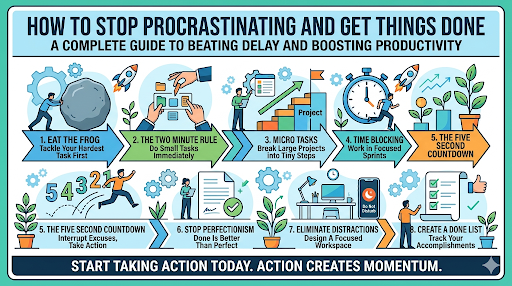
This is perhaps the most powerful tool for immediate momentum. The rule is incredibly simple. If a task takes less than two minutes to complete, you must do it immediately. Do not write it down. Do not schedule it for later. Just do it right then and there. Replying to a quick email, putting your coffee mug in the dishwasher, or making a quick phone call all fall into this category. Knocking out these tiny tasks clears your physical and mental space, giving you a quick burst of accomplishment that propels you toward bigger projects.Break Down Massive Goals Into Micro Tasks
One of the biggest reasons we freeze up is because a project feels too intimidating. If your goal is to write a book, that is terrifying. Your brain looks at that monumental goal and shuts down completely. The secret is to chop that massive project into ridiculously small, non threatening micro tasks. Do not put write a book on your daily planner. Put open up a blank document and write one single sentence. Once you take that first tiny step, the resistance usually crumbles, and you end up writing for an hour.Forgive Yourself For Past Delays
This might sound strange, but self compassion is a highly effective time management strategy. Research has shown that students who forgive themselves for procrastinating before a major exam are actually less likely to delay studying for the next exam. Beating yourself up creates more negative emotions, which we already established is the root cause of avoiding work. Acknowledge that you slipped up, let go of the guilt, and focus entirely on what you can do in the present moment.Eat The Frog First Thing In The Morning
The famous author Mark Twain once said that if it is your job to eat a live frog, it is best to do it first thing in the morning. In the world of productivity, your frog is your biggest, ugliest, most important task. It is the one thing you are most likely to avoid, but it is also the thing that will have the biggest positive impact on your day. Tackle your most difficult project before checking emails, before going on social media, and before the daily chaos begins. Once the frog is eaten, the rest of your day feels like a breeze.Use Time Blocking Intervals
Working endlessly without a break is a recipe for complete burnout. Instead, train your brain to work in highly focused, short sprints. Pick a single task, set a timer for twenty five minutes, and work with zero distractions. When the timer goes off, force yourself to take a five minute break to stretch, drink water, or look out the window. After four cycles of this, take a longer thirty minute break. This method creates a sense of urgency while also guaranteeing your brain gets the rest it needs to stay sharp.Design A Distraction Free Environment
Your environment dictates your behavior much more than your willpower does. If your phone is buzzing constantly next to your keyboard, you are going to check it. To get things done efficiently, you need to ruthlessly eliminate friction for good habits and increase friction for bad habits. Put your phone in another room while you work. Block distracting websites using browser extensions. Clean your desk so you have a clear workspace. Make it as easy as possible to focus and as difficult as possible to lose attention.Create A Done List Instead Of A Task List
We all have massive lists of things we need to do, and looking at them can induce immediate panic. Try flipping the script. At the end of the day, write down a list of everything you actually accomplished. Seeing a physical record of your progress provides a massive boost of dopamine and motivation. It reminds you that you are capable of being productive and sets a positive tone for the following morning.The Five Second Countdown
When you feel the urge to put something off, or when your alarm goes off in the morning and you want to hit snooze, simply count backward from five. Five, four, three, two, one, and then physically move. This simple countdown acts as a pattern interrupt in your brain. It stops your mind from generating excuses and shifts your focus from the emotional part of your brain to the logical, action oriented part.
Mindset Shifts For Lasting Productivity
Techniques and tricks are wonderful, but long term success requires a fundamental shift in how you view work and effort. You have to let go of perfectionism. Perfectionism is just procrastination wearing a fancy suit. We tell ourselves that if we cannot do something flawlessly, we should not do it at all. This is a trap. Remember that done is always better than perfect. A poorly written rough draft can be edited and improved, but a blank page gives you absolutely nothing to work with.
You also need to connect your daily actions to your broader life purpose. Why are you doing this work in the first place? If you are studying for a difficult exam, remind yourself of the career you want to build. If you are starting a fitness routine, focus on the energy and health you will enjoy in the future. When the deeper why is clear, the superficial resistance of the present moment loses its power over you.
Furthermore, you must start identifying as an action taker. The language you use internally dictates your reality. If you constantly tell yourself that you are lazy and that you always put things off, your brain will look for evidence to prove that statement true. Start telling yourself a new story. Say out loud that you are someone who finishes what they start. It might feel silly at first, but over time, your actions will begin to align with your new identity.
Reward Yourself For Good Behavior
Positive reinforcement is crucial. Your inner child is the one throwing a tantrum when it is time to work, so you need to bribe that inner child just a little bit. Set up a system of meaningful rewards for completing your tasks. If you finish your report by Friday afternoon, treat yourself to your favorite takeout meal or allow yourself a guilt free evening of watching movies.
The key here is that the reward must be strictly conditional on actually finishing the work. Do not consume the reward beforehand and promise you will do the work later. We all know how that story ends. By linking hard work with immediate positive outcomes, you slowly train your brain to associate focus and discipline with pleasure rather than pain.
Conclusion
Learning how to stop procrastinating and get things done is not about turning yourself into a robotic machine that works twenty four hours a day. It is about taking back control of your time, your energy, and your future. It is about understanding that motivation is a myth and that action must always come first. Motivation does not cause action. Action causes momentum, and momentum creates motivation.
You do not need to implement every single strategy mentioned in this guide all at once. That would only lead to more overwhelm. Start small. Pick just one technique, whether it is the two minute rule or eating the frog, and try it tomorrow morning. Forgive yourself when you stumble, because you will definitely stumble. The goal is progress, not perfection.
The time will pass anyway. A year from now, you will either be exactly where you are today, or you will be miles closer to your dreams. The choice is entirely yours. Close this browser tab, put your phone away, pick your most important task, and take that very first step. You have completely got this. Now go get things done.
Need help making the right career decision?
Explore KickStartX career counselling and education guidance services for personalised support, scientific assessments, and structured career planning.
Explore related KickStartX services
Continue from this topic to the most relevant counseling, admission, abroad studies, skills, and career pathway pages.