To Buy or Not to Buy: The Ultimate Real Estate Dilemma for Young Professionals
Welcome to the official starting gate of modern adulthood. You have got the degree, you land the job (or maybe your second or third job by now), and you are finally beginning to understand how taxes work sort of. You have mastered the art of cooking something other than ramen, and you might even own a plant that is still alive. Congratulations, you are a young professional. But just as you get comfortable, the universe, usually in the form of well meaning relatives or aggressive social media ads, drops the big question on you: "So, when are you going to buy a house?" It is the age old debate, newly packaged for the millennial and Gen Z crowd. Should you buy a home or continue to rent? This is not just a financial question; it is a lifestyle question, a career question, and honestly, sometimes a "how much stress can I handle" question. The pressure to buy is real. We grew up seeing homeownership as the ultimate sign of "making it." But the world has changed. The economy is different, career paths are different, and frankly, avocado toast is expensive. So, before you rush into a thirty year mortgage because your high school rival just posted a picture holding keys on Instagram, let’s break this down. Is buying the definitive smart move, or is renting the secret to freedom? Let’s dive into the great real estate debate.
To Buy or Not to Buy: The Ultimate Real Estate Dilemma for Young Professionals
Welcome to the official starting gate of modern adulthood. You have got the degree, you land the job (or maybe your second or third job by now), and you are finally beginning to understand how taxes work sort of. You have mastered the art of cooking something other than ramen, and you might even own a plant that is still alive. Congratulations, you are a young professional.
But just as you get comfortable, the universe, usually in the form of well meaning relatives or aggressive social media ads, drops the big question on you: "So, when are you going to buy a house?"
It is the age old debate, newly packaged for the millennial and Gen Z crowd. Should you buy a home or continue to rent? This is not just a financial question; it is a lifestyle question, a career question, and honestly, sometimes a "how much stress can I handle" question.
The pressure to buy is real. We grew up seeing homeownership as the ultimate sign of "making it." But the world has changed. The economy is different, career paths are different, and frankly, avocado toast is expensive. So, before you rush into a thirty year mortgage because your high school rival just posted a picture holding keys on Instagram, let’s break this down. Is buying the definitive smart move, or is renting the secret to freedom?
Let’s dive into the great real estate debate.
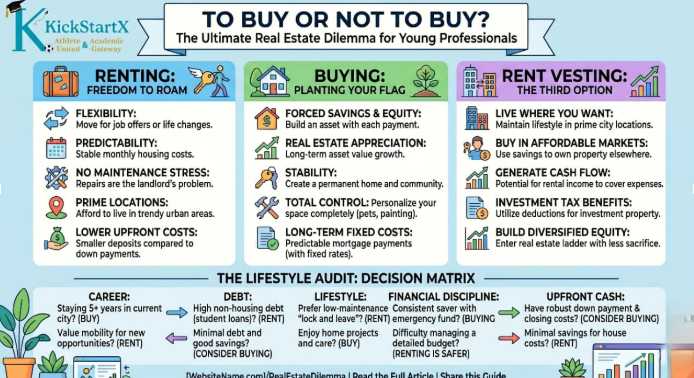
The Case for Renting: The Freedom to Roam
Renting has historically received a bad rap. It is often described as "throwing money away" or "paying someone else's mortgage." While technically true on the surface, this viewpoint overlooks the incredible value that renting provides, especially during the early to mid stages of a career.
For a young professional, flexibility is often your greatest asset. You might be in Atlanta today, but a promotion could send you to Seattle next year. Or maybe you decide you want to try freelance life from a beach in Portugal.
When you rent, you have this flexibility. You are generally committed for twelve months at a time. After that? You are free to move without the crushing logistics of selling a property.
Then there is the predictability. When you rent, you know exactly what your housing cost is every month. Your rent is X, and maybe utilities are Y. That is it.
If the water heater explodes at 3 AM on a Tuesday, do you know what you do? You do not panic. You do not worry about how you will pay the emergency repair bill. You simply call the landlord or property manager and go back to sleep. The absolute luxury of making repairs someone else's problem cannot be overstated. When you are focused on climbing the corporate ladder or building a business, you do not need the added stress of a plumbing crisis.
Furthermore, renting often allows you to live in prime locations that you might not be able to afford to buy in. You can enjoy the downtown loft, the walkability to the best coffee shops, and the easy commute, all without a massive down payment.
The Perceived Cons of Renting
Of course, renting is not perfect.
No Equity Building: The biggest financial argument against renting is that you are not building an asset. Your monthly payments make the landlord richer, not you.
Rising Costs: Rent rarely stays the same. Landlords can increase rent when your lease is up, sometimes significantly, forcing you to move even if you don't want to.
Lack of Control: You cannot easily paint the walls your favorite color, swap out the ugly light fixtures, or, sometimes, even own a pet without paying extra fees.
The Case for Buying: Planting Your Flag
Buying a home is the quintessential American dream. For many young professionals, it represents the moment you stop spinning your wheels and start making roots.
The primary argument for buying is financial: it is forced savings. When you pay your mortgage, a portion of that payment goes toward the principal balance of the loan. Each month, you own a tiny bit more of your house. Over ten, twenty, or thirty years, this adds up significantly.
When you couple this with the historical trend of real estate appreciating in value over the long term, you are essentially investing your housing payment rather than spending it.
But the financial aspect is only part of the story. Buying a home provides stability and a profound sense of ownership. It is yours. You can renovate the kitchen, tear out the carpets, and paint every room bright neon green if you really want to (though your future resale value might not appreciate that).
You do not have to worry about a landlord deciding they want to sell the building and giving you thirty days to move. This stability allows you to truly become part of a community, get to know your neighbors, and feel settled.
The Perceived Cons of Buying
However, buying a house is a significant commitment and involves some brutal truths.
Upfront Costs: This is the biggest hurdle for young professionals. You do not just need a down payment, which ideally is twenty percent of the purchase price, but is often less. You also need cash for closing costs, which include loan fees, attorney fees, inspection costs, and various other charges that feel like they are just making up words to take your money.
Maintenance: When you own, you are the landlord. If the roof leaks, you have to find the money (sometimes thousands of dollars) and the contractor to fix it. This requires a separate emergency savings account just for house related disasters.
Illiquidity: Real estate is an illiquid asset. If you need money quickly, you cannot just sell ten square feet of your living room. Selling a house is a long, expensive, and stressful process.
The Lifestyle Audit: Are You Actually Ready to Buy?
The debate between buying and renting is rarely purely about mathematics. It is primarily about where you are in your life and career. You could have a spreadsheet showing that buying is the better long term play, but if your career is in flux, buying a house would be a disaster.
As a young professional, you need to conduct an honest lifestyle audit. Ask yourself these critical questions:
How stable is your job, and where is it located?
Are you happy with your current employer? Is there a risk of layoffs? More importantly, where does your career path lead? If you are a specialized professional, the next big opportunity might require relocation. Buying a home anchors you to one location, which can significantly limit your career options. If you are not seventy five percent certain you will be in the same city for at least the next five to seven years, you probably should not buy.
What does your current debt situation look like?
Many young professionals graduate with student loan debt. When you buy a home, lenders look at your debt to income ratio. If you already have significant monthly payments for student loans or car loans, adding a mortgage might stretch you too thin. It might be smarter to tackle your high interest debt before taking on the massive debt of a mortgage.
What do you want your life to look like outside of work?
If your ideal weekend involves impulsive road trips, late nights at concerts, or simply doing absolutely zero home maintenance, owning a house might be a mismatch for your lifestyle. Owning a home often means your weekends involve trips to the home improvement store, mowing the lawn, or spending time arranging repairs. If you prefer a lock and leave lifestyle, where you can travel without worrying about who is watering your plants or if the pipes will freeze, renting is much more conducive to that freedom.
How is your financial discipline?
Renting is easy; you pay one bill. Owning a home requires serious budgeting. You need to budget for the mortgage, property taxes, insurance, home owners association fees (if applicable), and maintenance. Are you the type of person who saves for a rainy day, or do you spend what you earn? If you do not have a robust savings account and a habit of budgeting, the unexpected costs of homeownership can financially cripple you.
Breaking Down the Math: A Real World Scenario
We said it is not all about the math, but let’s look at the numbers for a second, keeping in mind we are avoiding any hyphenated terms. We will use a hypothetical example.
Let's imagine you are looking at a condo in a nice area for $350,000. You have a good salary and have managed to save $35,000 for a down payment (ten percent).
Scenario 1: Buying
Purchase Price: $350,000
Down Payment: $35,000
Loan Amount: $315,000
Upfront Closing Costs (estimated 3%): $10,500
Total cash you need to buy: $45,500
Now let's look at the monthly costs. Assuming a 7% interest rate for a 30 year fixed mortgage:
Mortgage Principal & Interest: Approximately $2,100
Property Taxes: $300
Home Insurance: $100
Condo/HOA Fees: $250
Maintenance Fund: $150 (saving for future repairs)
Total Monthly Cost of Buying: $2,900
In this scenario, a good chunk of that $2,100 principal and interest payment goes to interest in the early years. You are building equity, but slowly.
Scenario 2: Renting
Now, let's say you can rent a similar condo in the same building for $2,200 per month. Utilities are separate, but that is true in both scenarios.
Monthly Savings by Renting: $700 ($2,900 - $2,200)
But wait, we have to look at what you do with your savings.
You took your $45,500 (the money you would have used to buy) and put it into a diversified stock market investment account (like an index fund that tracks the S&P 500). Historically, that might return 7% to 10% on average annually.
If you invest that initial $45,500, plus the $700 monthly "savings" you have from renting instead of buying, over ten years, you could have a significant investment portfolio, potentially rivaling the equity you would have built in the home.
Real estate does not automatically beat the stock market, especially when you factor in the high transaction costs, taxes, and ongoing maintenance of a property.
Rent Vesting: The Third Option Nobody Talks About
We often present this as a strict binary choice: buy a home to live in, or rent and own nothing. But there is a middle ground that is becoming increasingly popular with young professionals. It is often called rent vesting.
Rent vesting is the concept where you continue to rent in the expensive city where you live and work, giving you the lifestyle and flexibility you desire. Meanwhile, you use your savings to buy an investment property in a more affordable market.
For example, you might rent an apartment in downtown New York, but use your down payment to buy a small single family home in a growing, affordable city like Charlotte or Austin.
The Pros of Rent Vesting:
Live Where You Want: You can maintain your high flexibility lifestyle in a prime urban location.
Start Building Equity: You are officially on the real estate ladder, owning an appreciating asset.
Potential for Cash Flow: If the rent from your investment property covers the mortgage and all expenses, you might even generate a small profit (cash flow) while someone else pays down your loan.
Potential Tax Benefits: Investment properties come with various tax deductions that are not available for your primary residence.
The Cons of Rent Vesting:
Being a Landlord is Work: Even with a property management company (which costs money), you still have responsibilities as the owner.
You Do Not Enjoy the Asset: You cannot live in your investment, so you are still dealing with the downsides of being a renter in your own life (rent increases, no control).
Higher Down Payments: Investment property loans often require a higher down payment (often 20% to 25%) than primary residence loans.
Summary: The Ultimate Decision Matrix
This is a lot to digest. Let's make it easy with a simple decision matrix.
Consider RENTING if:
You do not plan to be in your current city for more than three to five years.
Your career is demanding, and you do not want to deal with home maintenance or repairs.
You have high non housing debt (student loans, car payments).
Your down payment savings are minimal.
You value liquidity and having your money easily accessible.
You desire a low stress, predictable monthly budget.
You want to live in a prime location that you could not afford to buy.
Consider BUYING if:
You are settled in your career and plan to stay in the same city for at least five to seven years.
You have a stable income and a manageable debt load.
You have saved enough for a down payment (ideally 10 20%) plus closing costs.
You are financially disciplined and have an emergency fund for repairs.
You want forced savings and want to build long term equity.
You desire stability and want total control over your living space.
You are comfortable with the risks and responsibilities of homeownership.
Consider RENT VESTING if:
You want to build real estate equity but cannot afford (or do not want) to buy in your current expensive market.
You value the lifestyle and freedom of renting in your chosen city.
You have the capital for a higher down payment and are willing to take on the responsibility of managing an investment property.
Conclusion
So, young professional, should you buy or should you rent? The disappointing (but accurate) answer is: it depends.
The most important thing to remember is that you should not let pressure (societal, family, or social media) dictate one of the largest financial decisions of your life. Homeownership is a marathon, not a sprint. If you are not ready, rushing into it will lead to financial stress and regret.
Renting is not failure; it is a strategic choice. Buying a home is not the only path to wealth; it is one investment vehicle among many.
Take stock of your career trajectory, your financial health, and your desired lifestyle. Do not just look at what you can afford on paper; look at what you can manage emotionally. The "right" answer is the one that gives you the best foundation for a happy, successful, and stress manageable life.
Adulting means making these tough calls. Take a deep breath, close Instagram, open your budget, and make the decision that is best for you, not the one everyone else tells you to make.
Need help making the right career decision?
Explore KickStartX career counselling and education guidance services for personalised support, scientific assessments, and structured career planning.
Explore related KickStartX services
Continue from this topic to the most relevant counseling, admission, abroad studies, skills, and career pathway pages.